Agentic Coding
Top tech stories today across software, hardware, AI, and product launches. Senior engineer audience — skip rumour churn and pre-announcement leaks. Lead with shipping-now stories and what changed for builders.
← See today's latestAI Agents - Agentic Coding
The SOTA-skills repository is a comprehensive collection of 42+ engineering skills and rules designed to guide AI coding assistants (particularly Claude Code) in applying best practices across domains from security to cloud infrastructure. The library achieves measured improvements in best-practice coverage from ~59% to ~98% by routing task-specific rules into each turn rather than relying on static prompts. Key capabilities include five slash commands (/sota-resume, /sota-close, /sota-audit, /sota-deep-audit, /sota-report) for managing work sessions and audits, a task-to-skill router that automatically loads relevant rules based on your description, and extensive documentation on everything from secure coding patterns to compliance frameworks. The skills organize into domains like security, testing, databases, cloud infrastructure, and nine programming languages, each with rules files kept under 500 lines to enable incremental loading. Installation is available via Claude Code's plugin marketplace or by cloning and symlinking, with optional always-on routing that embeds the library's directives into every session so guidance persists through long contexts. The repo includes measured results against multiple models showing consistent gains on completeness, freshness of version/CVE facts, routing accuracy, and defect avoidance, plus extensive documentation on audit methodology, field-report submission, and gap analysis against standards like OWASP Top 10 and NIST frameworks. [Source: github]
Your CLAUDE.md file is probably too long and losing effectiveness. Anthropic recommends keeping CLAUDE.md under 200 lines because longer files cause Claude to ignore important rules as they get lost in noise. The key principle is: if Claude ignores a rule, your file is likely too long, not too short. Rather than adding more rules with emphasis like "IMPORTANT" or "YOU MUST", focus on including only what Claude cannot deduce from reading your code. Include concrete bash commands, code style rules that differ from defaults, testing instructions, and repository-specific architectural decisions. Exclude standard conventions Claude already knows, detailed API documentation (link instead), file descriptions, and self-evident practices like "write clean code". When your CLAUDE.md grows large, don't use @imports as they don't reduce context cost. Instead, use path-scoped rules to load instructions only for specific directories, or create nested CLAUDE.md files at different project levels. You can also delegate workflows to skills (for occasional tasks) and hooks (for things that must happen every time). Use anchor comments directly in code for corrections that only matter in specific places rather than loading them into every session. Treat CLAUDE.md like code: check it into git, prune stale rules regularly, use /context to verify what loads, and write your own tailored to your codebase rather than copying verbose examples from the internet. [Source: dev]
(Returning empty string as requested) The website content is a skills directory listing for a Claude Code skill called "setup-repo-skills" by oneafrikan. While it relates tangentially to the user's interest in Claude Code and agentic coding, the content is primarily a technical skill documentation page and installation instructions rather than news, recent developments, or best practices guidance relevant to the user's stated interests (efficient use of AI agents, advanced work with AGENTS.md, best practices for agentic coding, etc.). There are no news updates, latest developments, or actionable best practices summarized in this content. [Source: skillsdirect]
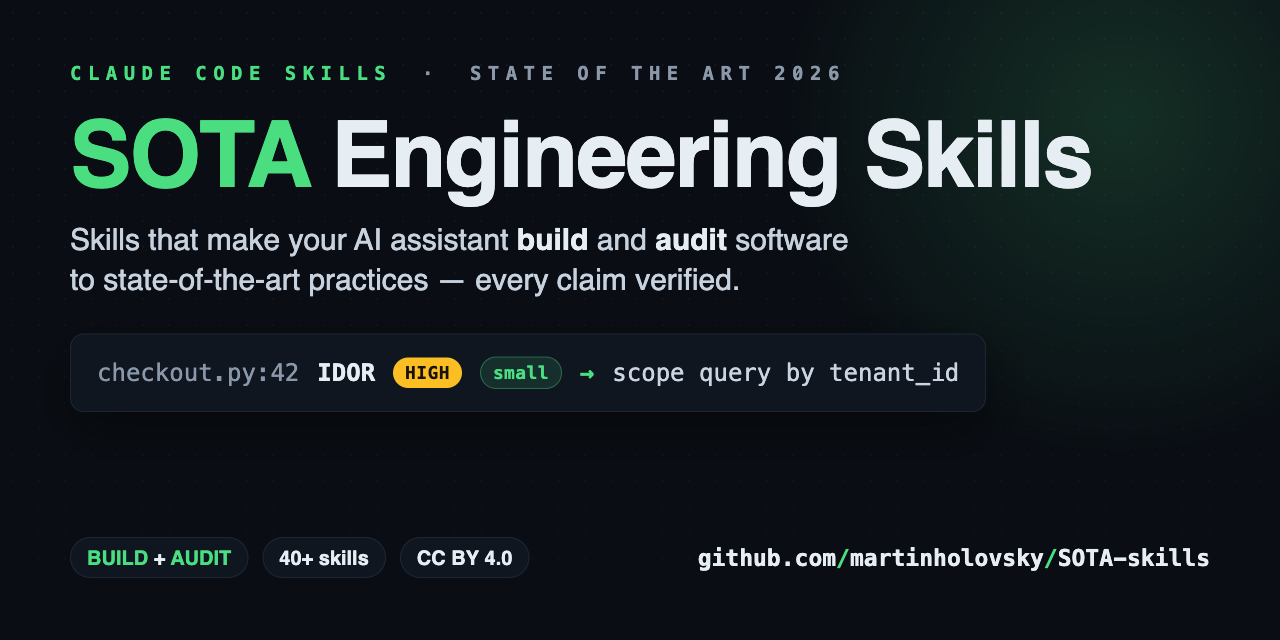 GitHub - martinholovsky/SOTA-skills: Engineering best practices that ...15 hours ago ... Native on Claude Code; works with Antigravity CLI, Codex, and any agent that reads AGENTS.md . Those agents get the skills and an always-on directive, but not ...github.com
 Your CLAUDE.md Is Probably Too Long - DEV Community11 hours ago ... Anthropic's guidance is to target under 200 lines per CLAUDE.md file: "Longer files consume more context and reduce adherence." The claude-code-best-practice ...dev.to