AI developer tools · What shipped
For a senior engineer who already reads HN. Real changes in AI developer tools today: releases with version numbers, papers with benchmarks, repos that crossed a threshold worth knowing. Skip hype threads, pre-announcement leaks, and recycled summaries. Always link primary sources.
← Zur aktuellen AusgabeOpenAI cuts GPT-6 pricing 50%; Anthropic & Fireworks ship token-efficient models
OpenAI GPT-6 Sol & Luna
OpenAI just halved pricing on two new GPT-6 variants.
Sol and Luna launched today in the API with input costs at $2 and $0.10 per million tokens respectively—both down 50% from GPT-5.6 [Quelle: MarkTechPost]. On AutomationBench, Sol outperforms Claude Opus 5 at 11x lower cost per task; Luna matches Opus 5 and Fable 5 on DeepSWE coding while costing 93–96% less. Both ship with improved prompt caching—up to 90% discounts on cached reads and new developer dashboards for cache diagnostics.
The tier below Astra just reset cost-performance.
Claude Fable 5.1 & Mythos 5.1
Following yesterday's update, Fable 5.1 adds new safeguard depth.
The model now ships with enhanced cybersecurity defenses that reduce false positives by 60% and explicit support for vulnerability discovery in defensive work [Quelle: Anthropic]. Mythos 5.1—the identical model with permissive safeguards for vetted security and life sciences professionals—gains Enterprise Frontier Safeguards enabling zero-data-retention deployments on customer infrastructure rolling out this fall. Cache reads stay at $0.25 per million tokens, holding the 45% cost advantage for agentic workloads.
Security teams and biotech labs get production-grade models for the first time.
Fireworks Ember-1
Token-efficient reasoning just hit production at scale.
Fireworks Research released Ember-1, a model matching Kimi K3's quality while slashing token use by 40% through learned selective reasoning [Quelle: Fireworks]. Live A/B tests with production customers on coding tasks confirmed 35% fewer tokens per task at parity quality; one customer now runs Ember-1 in production. The model built on Fireworks Serverless Training and ships today as a research preview with enterprise training support to enable custom token-efficient variants.
Token reduction just moved from research into live inference.
Gemini 3.8 Flash & Muse Spark 1.3
Google and Muse stake claims on cost-performance efficiency.
Gemini 3.8 Flash lands three variants on Artificial Analysis' intelligence index with the high-tier model at 41 capability points, 291 tokens/second output speed, and competitive pricing via the medium tier at $0.93 per task [Quelle: Artificial Analysis]. Muse Spark 1.3 counters with two variants, peaking at 48 capability points on the same index and pricing the xhigh-speed tier at $1.37 per task. Both models evaluated on 10 benchmarks spanning finance, strategy, legal, healthcare, and engineering domains.
The middle tier just got denser with options.
 Gemini 3.8 Flash: Release Intelligence, Performance & Price12 hours ago ... The Gemini 3.8 Flash release offers 3 models, each with different intelligence, performance, and pricing characteristics. Below is a comparison of the key ...artificialanalysis.ai
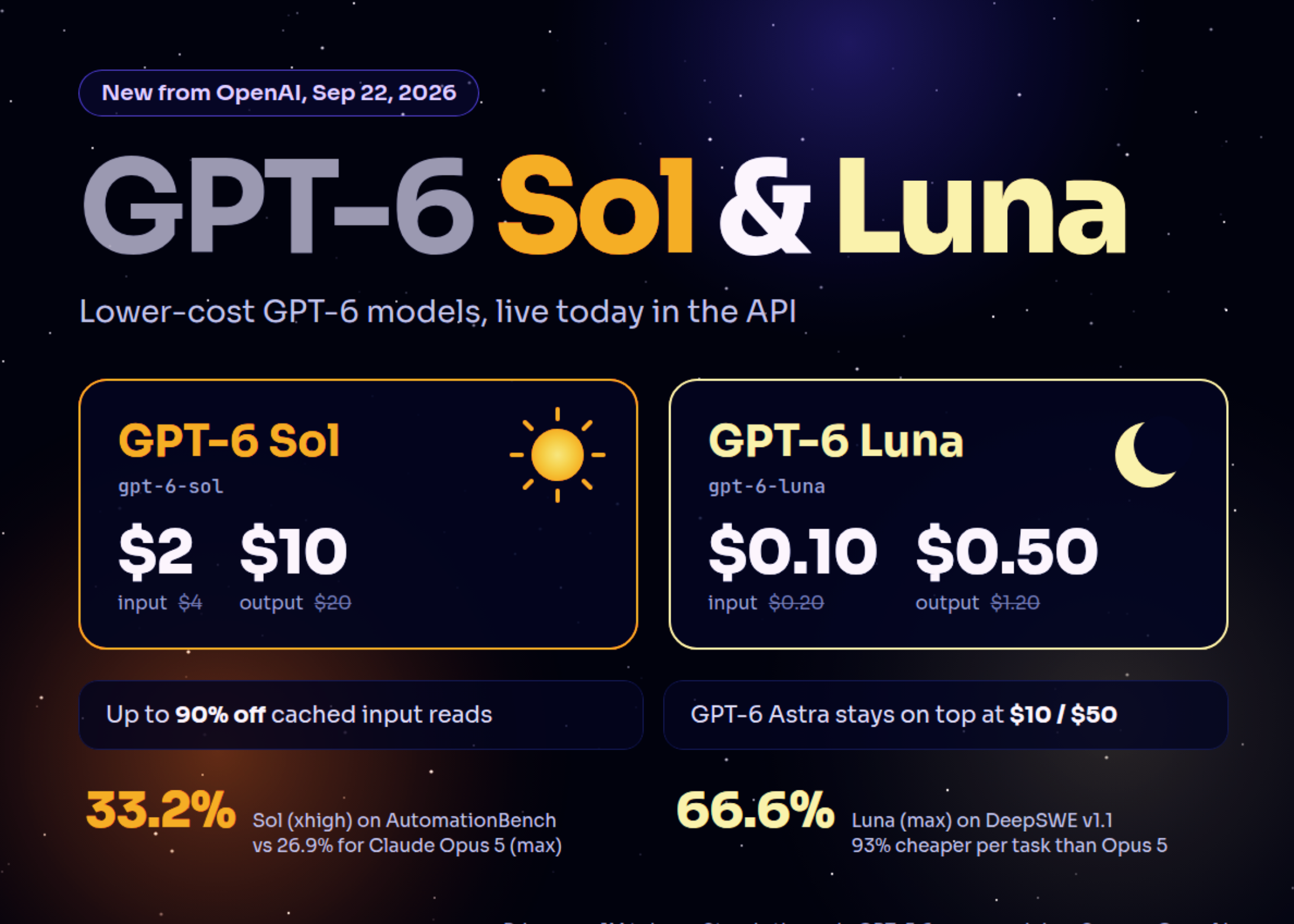 OpenAI Releases GPT-6 Sol and Luna: 50% Cheaper API Pricing ...24 hours ago ... ... Model Averaging 53.9 Across 34 Benchmarks and Built to Run On Device. > /scale_b2b_pipelineSPONSOR. 1M+. Monthly readers. AI engineers, researchers and founders.marktechpost.com
 Introducing Claude Fable 5.1 and Claude Mythos 5.1 - Anthropic3 hours ago ... ... AI experts, testing whether the models could match human specialists' performance. ... model releases. A small number of customers' custom integrations ...anthropic.com
 Introducing Ember-1 - Fireworks AI7 hours ago ... Your AI performance stack is Fireworks + Voyage AI · fireworks kimi logo lockup. Model Releases6/12/2026. Kimi K2.7 Code on Fireworks: Better Agents, Lower Cost ...fireworks.ai