AI developer tools · What shipped
For a senior engineer who already reads HN. Real changes in AI developer tools today: releases with version numbers, papers with benchmarks, repos that crossed a threshold worth knowing. Skip hype threads, pre-announcement leaks, and recycled summaries. Always link primary sources.
← Zur aktuellen AusgabeFable 5.1 and Mythos 5.1 ship; typed-decision models arrive; benchmarks scale
Claude Fable 5.1 & Mythos 5.1
Anthropic's new models widen the coding lead further.
Fable 5.1 and Mythos 5.1 ship with 75% cheaper cache reads at $0.25 per million tokens—delivering up to 45% cost cuts on agentic workloads [Quelle: Anthropic]. Terminal-Bench 4.0 holds at 60.9% for Mythos; Humanity's Last Exam with tools reaches 65.0%. Mythos 5.1 adds 60% fewer false positives in safety checks and advanced scientific capabilities—protein design hit rates near 50% across targets versus typical 10–15%—making it the first model to reach usable biotech performance.
Cost per reasoning task just reset the bar.
TypeSafe Jev: decision-only model
A new model class swaps text generation for typed decisions.
TypeSafe released Jev on September 15—the first "System One" model returning calibrated probabilities over enumerated choices instead of autoregressive tokens [Quelle: Developers Digest]. Responses land in 70–500ms at $0.042 per million input tokens with zero hallucination risk and schema guarantees. On workflow evals it hits 76% accuracy while costing 25–145x less than frontier models and running 193.6x faster.
Classification, routing, and extraction just became a different product tier.
Epoch AI benchmarks expand; GPT-6 Astra first solver
The math benchmark now tracks what was unsolvable last week.
Continuing the earlier breakthrough, Epoch AI's FrontierMath Erdős benchmark—68 unsolved problems where systems write proofs in Lean—remains the frontier. GPT-6 Astra solved 2 of 68 (3%) [Quelle: Epoch AI]. The benchmarking hub now covers 390 models across 80 tasks with published eval code and model outputs for reproducibility via the Inspect framework.
Leaderboards just became auditable.
LiteLLM Rust Gateway latency halves
Open-source gateways just got 3.5x faster.
LiteLLM's Rust AI Gateway benchmarks show 0.66 ms p99 latency—undercutting Portkey (2.29 ms) and Bifrost (4.54 ms)—handling 2,800+ requests per second at ~21% CPU [Quelle: LiteLLM]. The MIT-licensed gateway supports 140+ providers and 1,892 unique models with day-zero support for new releases and optional enterprise SSO and audit trails.
Platform teams get a production-grade router without the vendor lock-in.
 Introducing Claude Fable 5.1 and Claude Mythos 5.1 - Anthropic3 hours ago ... ... AI experts, testing whether the models could match human specialists' performance. Mythos 5.1's capabilities are greater than those of Mythos 5. However ...anthropic.com
 AI Benchmarks & Capabilities - Epoch AI7 hours ago ... Our hub for benchmark results, featuring the performance of leading AI models on challenging tasks. It includes results from benchmarks administered ...epoch.ai
 TypeSafe Jev: the First Decision-Only Model Class, Benchmarked ...12 hours ago ... NewsAI ModelsDeveloper Tools. TypeSafe Jev: the First Decision-Only Model ... releases Mercury Two, a reasoning diffusion-based LLM that exceeds 1,000 tokens p.developersdigest.tech
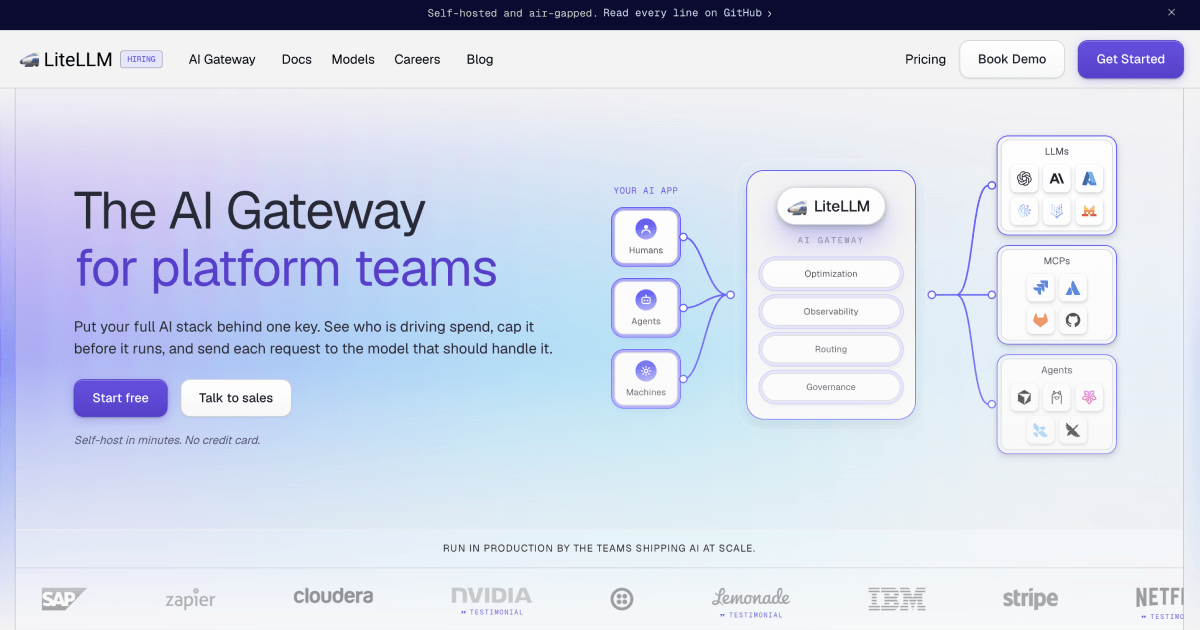 LiteLLM — Open-Source AI Gateway & LLM Proxy7 hours ago ... LiteLLM is the open-source AI gateway that puts your full AI stack behind one OpenAI-compatible key. Track and cap LLM spend, route to the right model, ...litellm.ai