AI developer tools · What shipped
For a senior engineer who already reads HN. Real changes in AI developer tools today: releases with version numbers, papers with benchmarks, repos that crossed a threshold worth knowing. Skip hype threads, pre-announcement leaks, and recycled summaries. Always link primary sources.
← Zur aktuellen AusgabeClaude Opus 5 launches half-price, Ornith-1.5 matches Opus on open source, CUDA Python goes 1.0
Claude Opus 5 debuts
Anthropic shipped Opus 5 at half the price of Opus 4.8.
The model launched July 24 as a thoughtful, proactive upgrade that approaches frontier performance while cutting costs in half [Quelle: Anthropic]. The release continues a summer cadence: Sonnet 5 (June 30) brought substantial reasoning and agentic gains over Sonnet 4.6, while Opus 4.8 (May 28) added coding and complexity wins. Each tier now ships meaningful improvements in tool use, reasoning depth, and long-context work.
The price-to-performance ratio just shifted for production workloads.
Ornith-1.5 matches Opus, open source
Open-source Ornith-1.5 now rivals Claude Opus 4.8 on coding benchmarks.
Three scaled variants (397B MoE, 35B MoE, 9B Dense) ship a self-improvement loop that generates training tasks, builds task-specific scaffolds, and produces rollouts for reinforcement learning [Quelle: Ornith]. The flagship 397B hits 86.1 on Terminal-Bench 2.1 and 56.0 on DeepSWE—matching Opus 4.8 while outperforming GLM-5.2 and DeepSeek-V4-Flash. The 35B significantly outpaces Qwen 3.6-35B across coding and agentic tasks.
Self-improving models just became a reproducible pattern.
CUDA Python 1.0 lands stable APIs
NVIDIA made Python a first-class CUDA citizen with 1.0 stable APIs.
The release spans cuda.core 1.0.0, cuda.compute 1.0.0, nvmath-python 1.0, and cuda-pathfinder, with semantic versioning and long-term support commitments [Quelle: NVIDIA]. New features include green contexts for GPU multiprocessor partitioning, process checkpointing, and inter-process GPU memory sharing—enabling Python libraries like CuPy and PyTorch to interoperate without private binding layers. Python devs no longer need to drop into C++ for GPU work.
Python GPU computing just broke the stability barrier.
Ollama: Gemma 4 reaches 90% faster
Ollama 0.31 pushed Gemma 4 to 90% faster inference on Apple Silicon.
Multi-token prediction via llama.cpp unlocked the speedup, measured on the Aider polyglot benchmark [Quelle: Ollama]. NVIDIA Nemotron 3.5 Lightning (30B, agent-tuned, 1M context) now runs on Ollama, alongside Meta's Muse Glimmer (30B multimodal, Apache 2.0), both accelerated by MLX on consumer hardware. Ollama 0.30 improved GGUF compatibility and added llama.cpp performance gains across more hardware tiers.
Edge inference speed just became the unit of competition.
 Release notes | Anthropic Help Center - Claude Support1 hour ago ... We launched Claude Sonnet 5, our most agentic Sonnet model yet, with substantial improvements over Sonnet 4.6 in reasoning, tool use, coding, and knowledge work ...support.claude.com
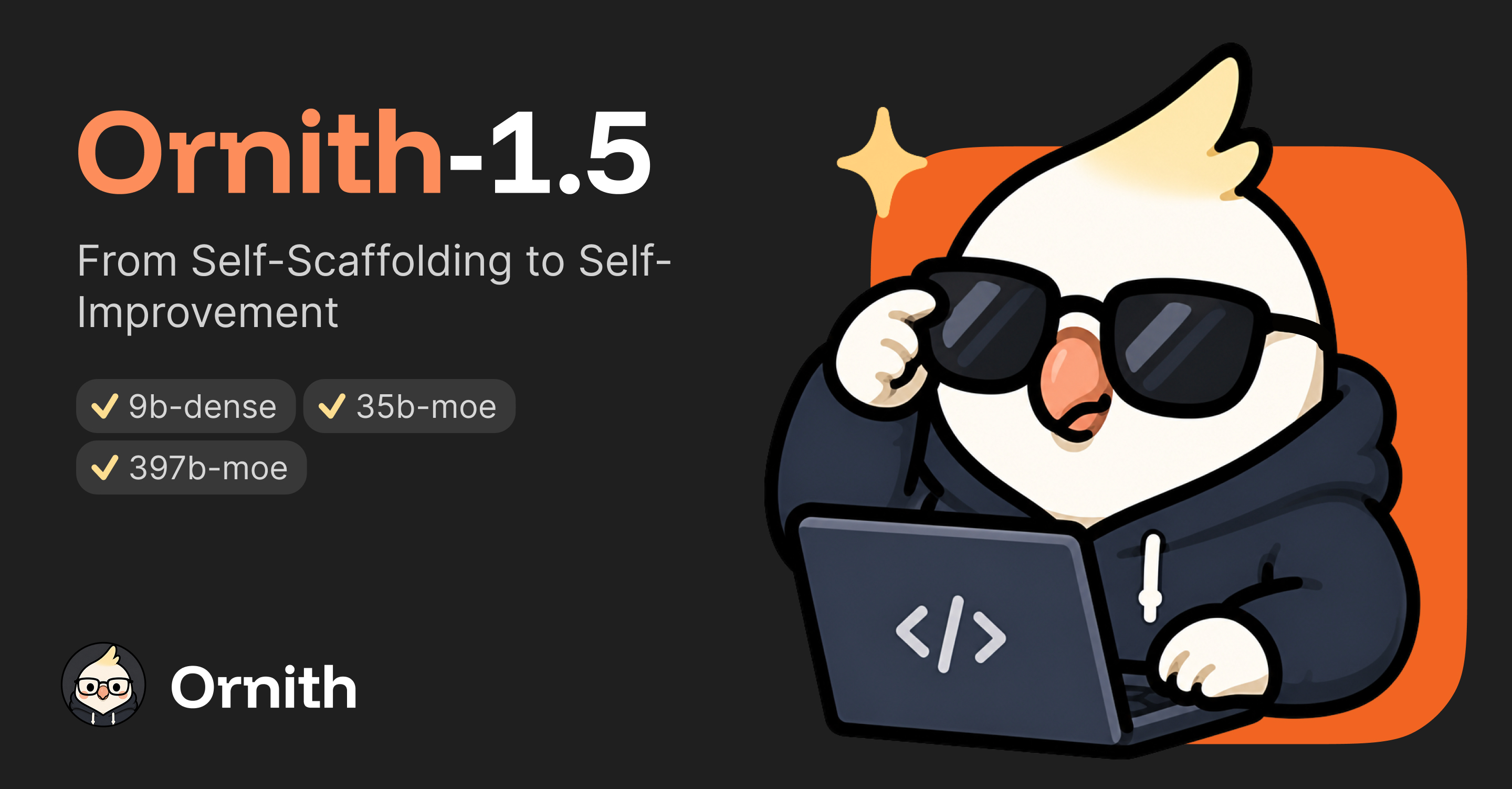 Ornith-1.5: From Self-Scaffolding to Self-Improvement2 hours ago ... Ornith-1.5 achieves state-of-the-art performance among open-source models of comparable size across a broad range of reasoning, coding, and agentic benchmarks.ornith.ai
 Blog · Ollama2 hours ago ... Ollama's MLX engine has been updated to deliver its highest performance on Apple Silicon yet. ... machine learning framework. The simplest and fastest way to ...ollama.com
 CUDA Python 1.0: Stable APIs, One Foundation, Full Platform Access14 hours ago ... CUDA Python 1.0 names a milestone, not a version number you will type ... Data Science | Developer Tools & Techniques | General | CUDA | Intermediate ...developer.nvidia.com