AI developer tools · What shipped
For a senior engineer who already reads HN. Real changes in AI developer tools today: releases with version numbers, papers with benchmarks, repos that crossed a threshold worth knowing. Skip hype threads, pre-announcement leaks, and recycled summaries. Always link primary sources.
← Zur aktuellen AusgabeMeta Muse Spark 1.2, Devin Desktop SWE-1.6, oMLX dev track
Meta Muse Spark 1.2
Meta's coding model just got faster and cheaper.
Muse Spark 1.2 shipped August 5 with agentic knowledge-work performance jumping 260 Elo on GDPval-AA v2 benchmarks, now reaching 54 on the Artificial Analysis Intelligence Index [Source: WhatLLM]. The model expanded to one-million-token context and priced at $0.10/$0.20 per million input tokens on contributor tier—undercutting mid-tier rivals by roughly 12x. Muse Code, a terminal agent bundled with the release, handles repository-scale work with persistent background workers and replay-safe crash recovery over 24-hour windows.
The harness-tight coupling means performance degrades outside Meta's environment—a bet other vendors must now match or lose on price.
Devin Desktop SWE-1.6
Devin's local-first IDE just got faster and freer.
The desktop environment ships SWE-1.6, described as the fastest coding model available, with unlimited free access and an Agent Command Center for coordinating multiple coding agents [Source: Devin]. Fast Context enables millisecond codebase searching, while new integrations via MCP Servers span Slack, Linear, ESLint, Prettier, Sentry, and others. The Agent Client Protocol now lets work flow across different models and agents without vendor lock-in.
Over one million users and 4,000+ enterprise customers now have laptop-to-cloud handoff built in.
Amp Code productivity push
Amp shipped five efficiency wins in two weeks.
Between late July and August 7, the frontier-agent platform released live reloading for testing agent changes, expanded file uploads to handle videos and logs, cut orb operational costs, and added event-driven capabilities for receiving external requests [Source: Amp Code]. The platform also demonstrated model flexibility by swapping its default model without user friction—a signal that vendor lock-in on inference is weakening.
Rapid iteration on developer UX hints at a market racing to make agents feel less like API wrappers and more like native workbench partners.
oMLX dev releases
The Apple Silicon inference server keeps pace with frontier models.
oMLX 0.5.4 now ships native DeepSeek V4 Flash with DSpark Lightning MTP achieving up to 85.6% faster code decoding, plus Ling 3.0 Flash support with FP8 and mixed FP4/FP8 checkpoint options [Source: GitHub]. Subsequent dev builds (0.5.7, 0.5.8.dev1, 0.5.8.dev2) address tool-call parsing, memory growth in cache ops, and dual-stack networking—the unsexy work that keeps local inference reliable at scale.
Watch whether local inference performance on M-series Macs closes the gap to cloud-hosted models for on-device agentic tasks.
 Meta Is Back in the AI Race: Muse Spark 1.2 Explained | WhatLLM.org19 hours ago ... A year ago, Meta could not launch an AI model without starting an argument about whether its benchmarks were real. This week it released a coding agent ...whatllm.org
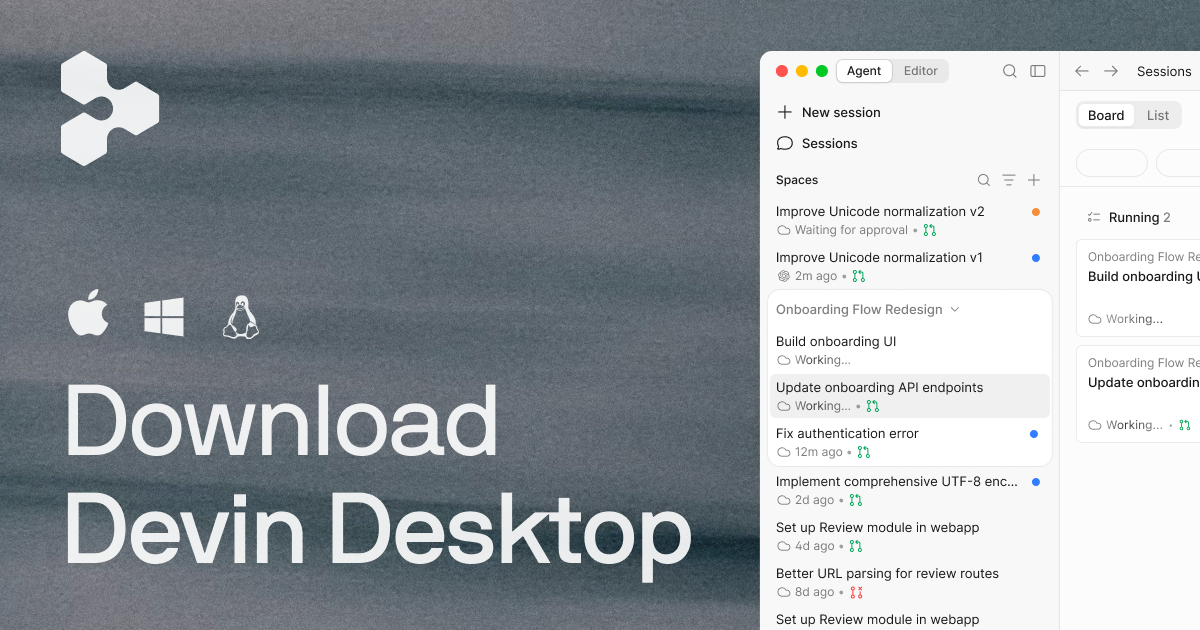 Devin Desktop23 hours ago ... every engineer. Devin Desktop is the home for coding agents to do your best work. You decide what to build, then your agents write the code ...devin.ai
 Amp Code22 hours ago ... Amp is the frontier agent, for people who want the most out of an agent, rather than keeping their old ways. On the web, in your terminal, and on your phone ...ampcode.com