How to Get Daily Fintech News as a Product Manager — Regulation, Rivals and Rounds in One Email
Published July 3, 2026
Your competitor just shipped the feature that was sitting in your Q3 roadmap — and you heard about it from a customer. Week three, not day one.
Good news — you're in the right place! About two minutes of setup gets you a daily fintech brief, and the first edition is free.
In this guide, I'll show you how to get daily fintech news as a product manager using MorningMail, a tool I built. Every morning, an AI agent searches the web fresh and writes you one short email: PSD3 and MiCA, competitor moves, the funding that matters — primary sources linked.
So, let's dive in!
What you'll build
Every fintech newsletter has a beat: payments, crypto, banking, lending. Your product crosses two or three of those, plus a vertical nobody covers. Covering all of that with subscriptions means an hour of skimming — mostly about markets you don't operate in.
MorningMail inverts that. You write one instruction describing what you build and what moves your decisions, and every morning an agent searches fresh and writes the email against it. It's not a link forwarder like Google Alerts: a BaFin circular and a Stripe pricing change can share one paragraph if both touch your product.
And your prompt carries your context permanently, so the brief evolves at roadmap speed. Entering the Dutch market? Add a clause tonight and DNB coverage appears tomorrow. Killed the crypto feature? Delete a word and the MiCA noise drops out.
See it live: yesterday's edition
So here's a real example. This is yesterday's edition of exactly this newsletter — written by the agent yesterday morning, based on the example prompt from this guide. Not a mockup: I run it myself on MorningMail.
Edition from October 6, 2026
SEC clears zero-cash brokers, banking agencies soften fintech rules, cross-border payments scale
SEC zero-cash balance relief
The SEC just cleared a new brokerage model that strips cash from the broker's books.
On September 17, the SEC Division of Trading and Markets issued no-action letters to eToro USA Securities and Alpaca Securities permitting "zero cash balance" accounts where customer funds sit with external banks or money services businesses instead [Quelle: Freewritings Law]. The relief specifies net capital minimums and conditions tailored to each firm's role—eToro as an introducing broker, Alpaca as a carrying firm. This removes a structural barrier to lighter-weight brokerage infrastructure.
Expect more brokers to file for similar relief now that precedent exists.
Banking agencies embrace fintech partnerships
Regulators are finally making it easier to partner with fintechs.
On September 11, the Federal Reserve, FDIC, OCC, and NCUA released proposed guidance replacing their 2023 third-party risk framework with a risk-focused approach that explicitly welcomes newer fintechs without long track records [Quelle: JDSupra]. The shift abandons "critical activities" prescriptive definitions in favor of "higher-risk" relationship assessments, loosens inventory requirements, and permits co-ventures and standards-body governance. Comments close November 16. However, banks remain liable for third-party failures, and the Agencies signaled intent to enforce directly against fintech service providers for critical systems breaches.
The framework is permissive on entry, strict on failure.
IPID raises $16M for payments intelligence
Cross-border payments just got a new layer of validation.
Singapore fintech IPID closed a $16 million Series A led by Foundation Capital and backed by Citi and HSBC, focusing on payment validation and account identification across 50+ countries [Quelle: DealStreetAsia]. Founded by former SWIFT employees in 2021, the firm reported $0.31 million revenue in 2024 (up from $0.04 million in 2023) and plans to expand into US payment rails and digital assets. Capital deployment targets global network expansion and US/Europe growth.
Watch for announcements on US payment rail infrastructure partnerships within the next two quarters.
 SEC Staff Issues No-Action Relief for “Zero Cash Balance ...11 hours ago ... The Staff stated that it will not recommend enforcement action against eToro ... The letters are notable as they provide a regulatory pathway for fintech ...freewritings.law
 Banking Agencies Issue Proposed Updated Third-Party Risk ...7 hours ago ... The Proposed Guidance signals a greater acceptance of bank-fintech partnerships and a focus on addressing material financial risks and violations of laws and ...jdsupra.com
 SG fintech startup IPID raises $16m in Series A funding9 hours ago ... In a statement, IPID said existing investors QED Investors, Monk's Hill Ventures and Quona Capital also took part in the funding round. Other institutional ...dealstreetasia.com
One click creates your own editable copy — change the prompt, the delivery time, everything.
Browse all editions →You could get this general version into your inbox right now — and then fine-tune it to your very specific needs. Here's how to do it:
Step by step: from zero to your first edition
The whole setup takes about two minutes. And every screenshot below comes straight from the real product — nothing is mocked up.
Step 1 Open morningmail.ai
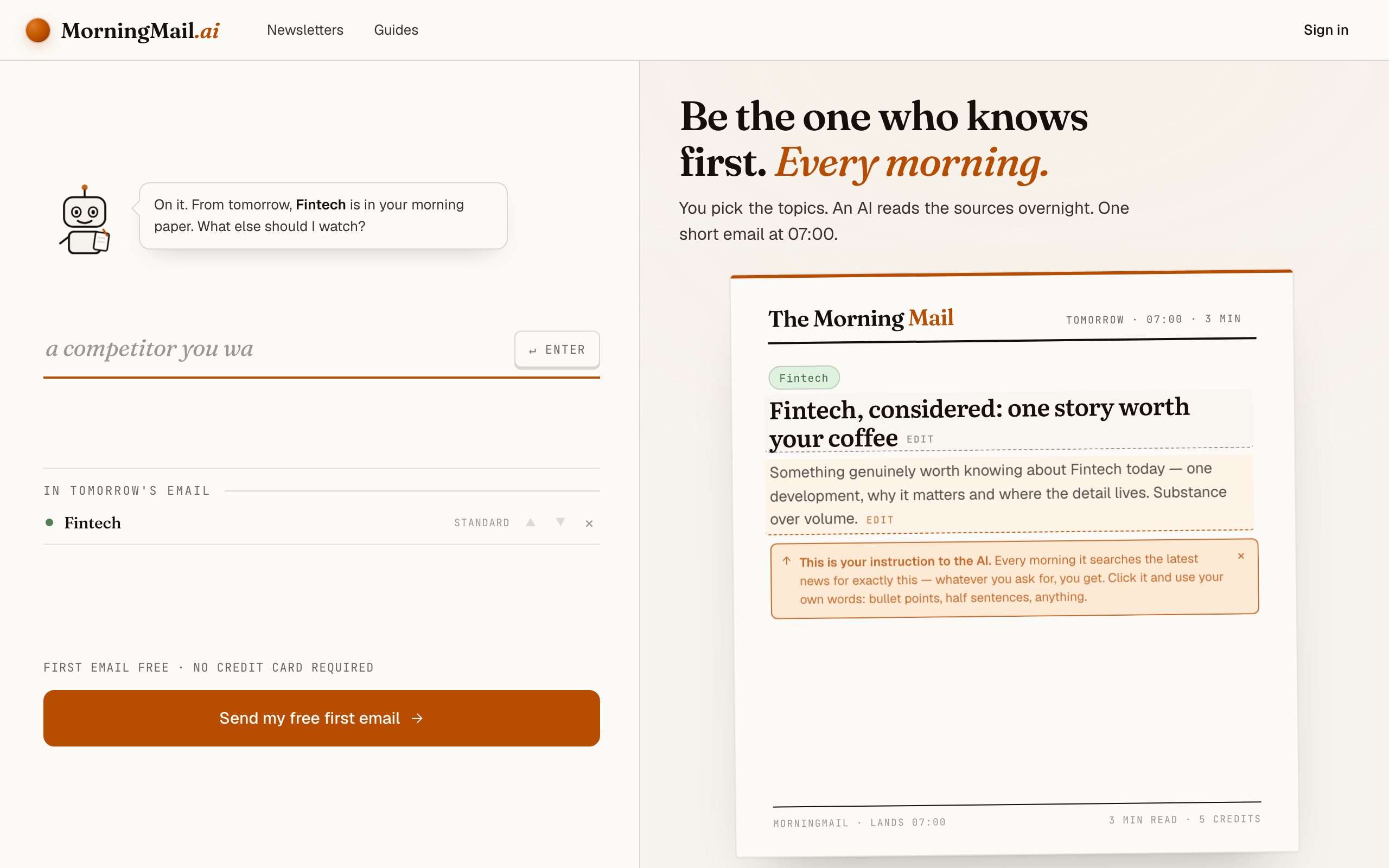
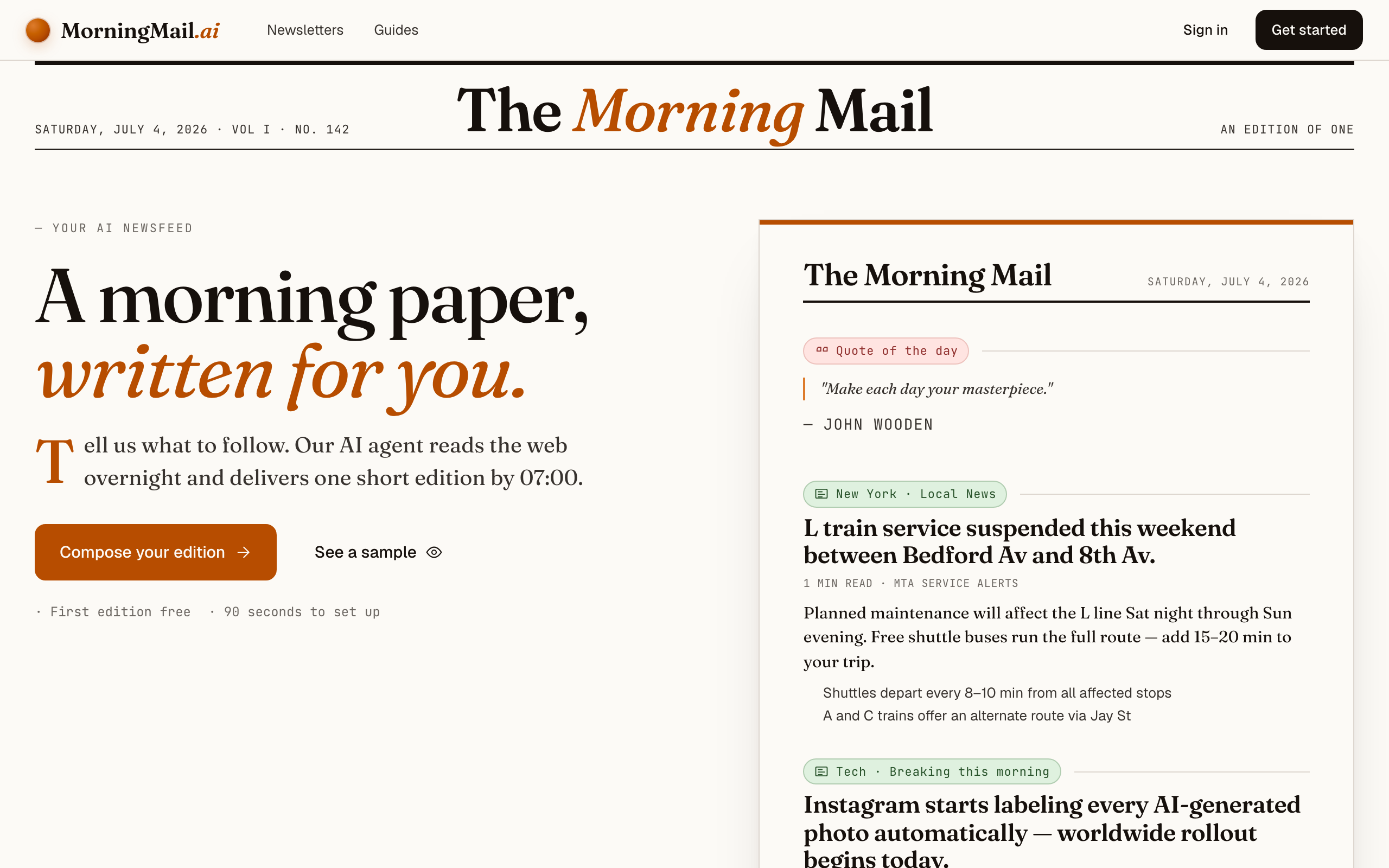
No account yet, nothing to install — the landing page IS where you compose. A friendly press robot introduces itself above one big input, and beside it a sample morning shows you what the email looks like before you have typed a word.
Step 2 Type your topic: Fintech
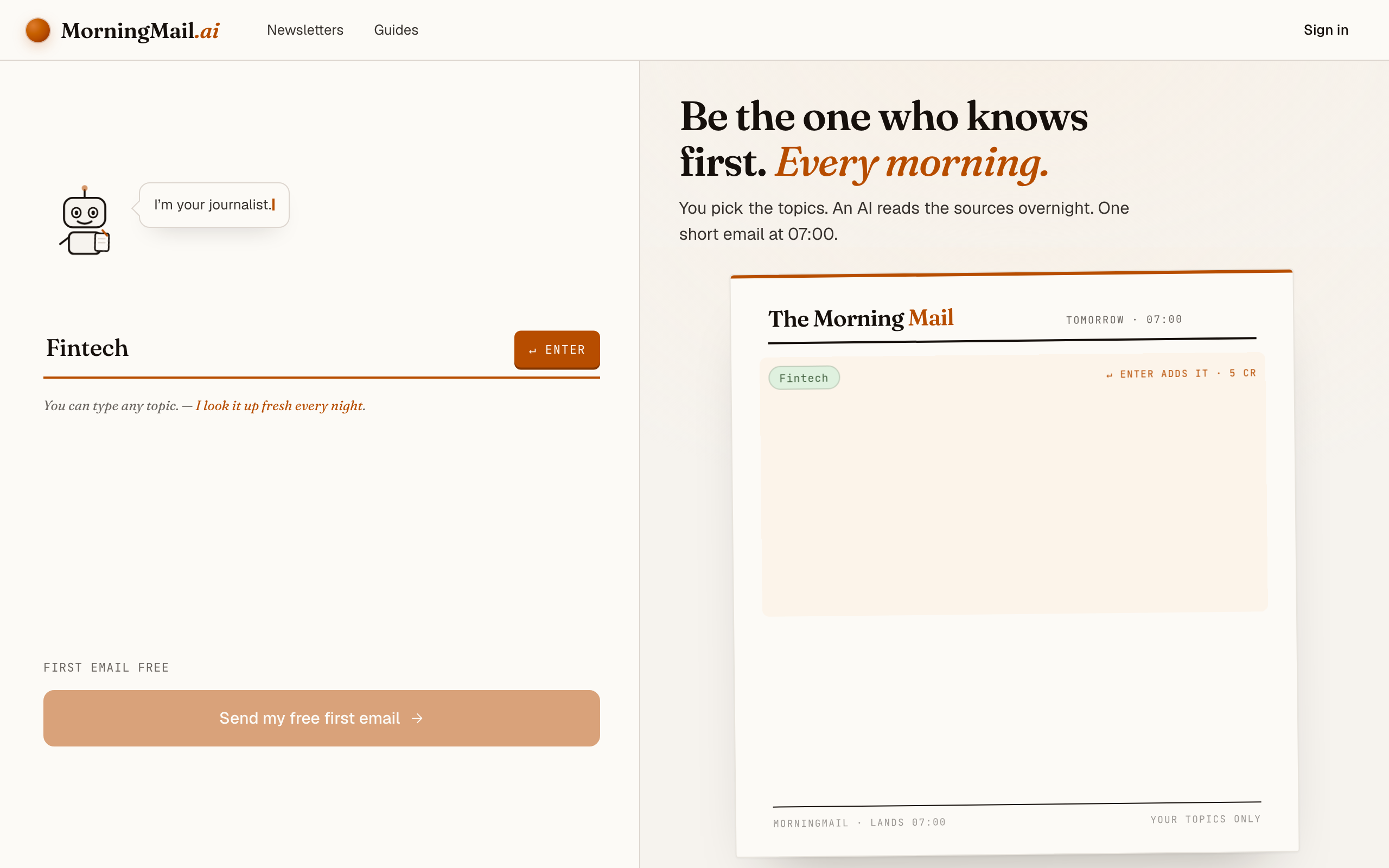
Type Fintech into that one input. There is nothing to pick and no form to fill — as you type, a draft section forms on the paper beside you, carrying your topic in a tinted badge and the quiet prompt "↵ Enter adds it", and the ↵ Enter key at the end of the input turns orange.
Step 3 Press Enter (or that orange key) — and read what the agent was told
No setup screen, no sign-up first: the landing page is the desk. Type Fintech into the one input, press Enter, and the section lands with a beat badge, a suggested headline and an Assignment — real prose about what moved overnight, why it happened and who said it, original source only. That text is literally what your agent executes every morning, and it exists before your account does.
Run it as-is for a week, then sharpen it around your product. Click the Assignment and rewrite it in your own words — for example: "My product is a B2B payments app under an EMI licence in Germany. Prioritise PSD3 and MiCA, BaaS provider news, and launches by Adyen, Stripe or local neobanks; funding only above Series B in Europe." The tweaks sitting under the field append a line each if you're in a hurry — "+ name sources" and "+ go deeper" earn their place in a regulation-heavy beat.
The exact prompt your section starts withSomething genuinely worth knowing about Fintech today — one development, why it matters and where the detail lives. Substance over volume.
Step 4 Send your free first email
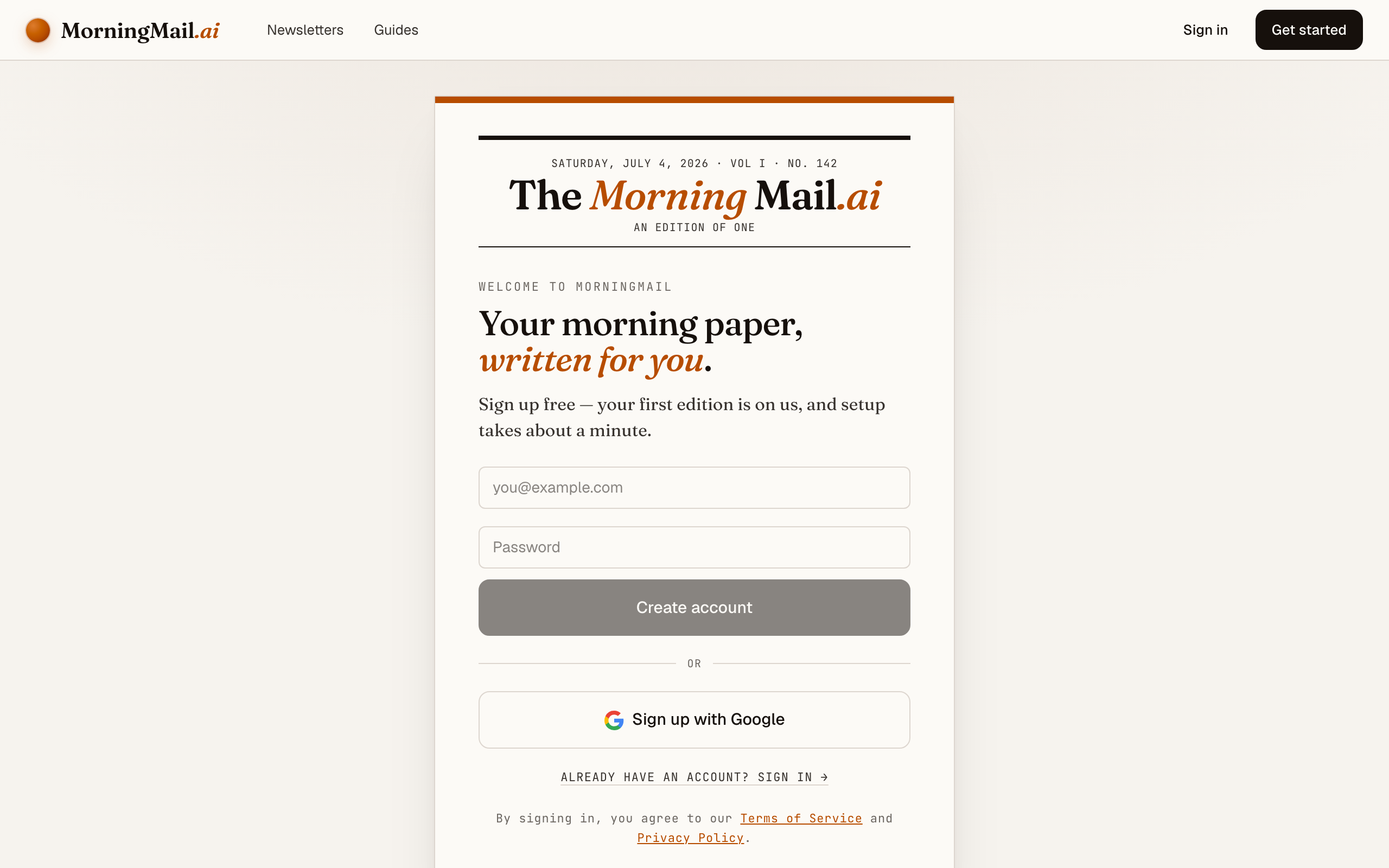
Happy with the paper? Hit “Send my free first email”. The sign-up appears right there — the paper never leaves the screen — and asks the only thing it still needs: where to send it. Email and password, or Google. No card, and the first email is free.
Step 5 Watch it being written
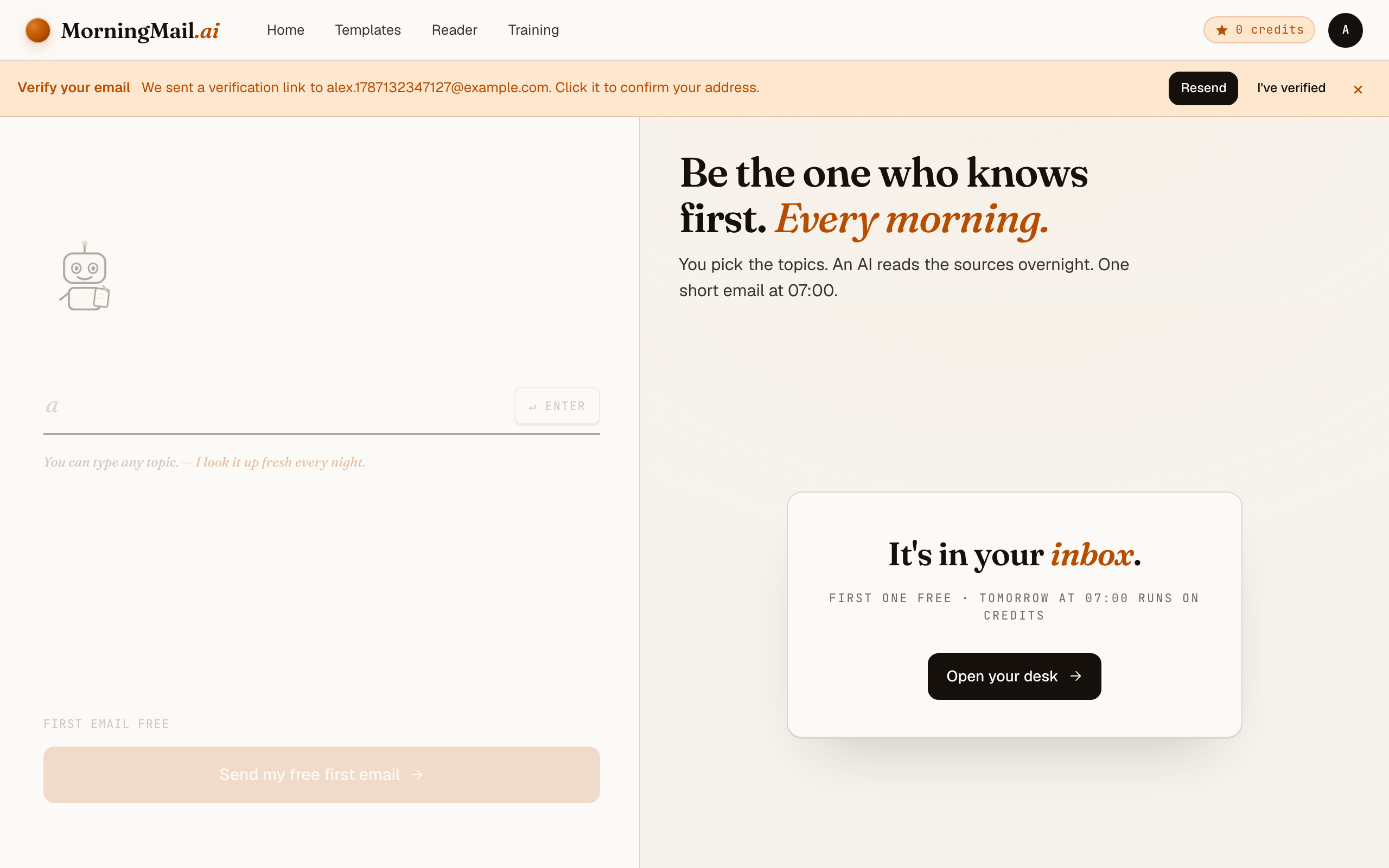
Now the desk goes to work in front of you: working out what to look for, searching the web, reading the best sources, writing your section, composing a subject line, handing it to the post. A minute or two later: "It's in your inbox."
Step 6 Afterwards: the time, the days, the readers
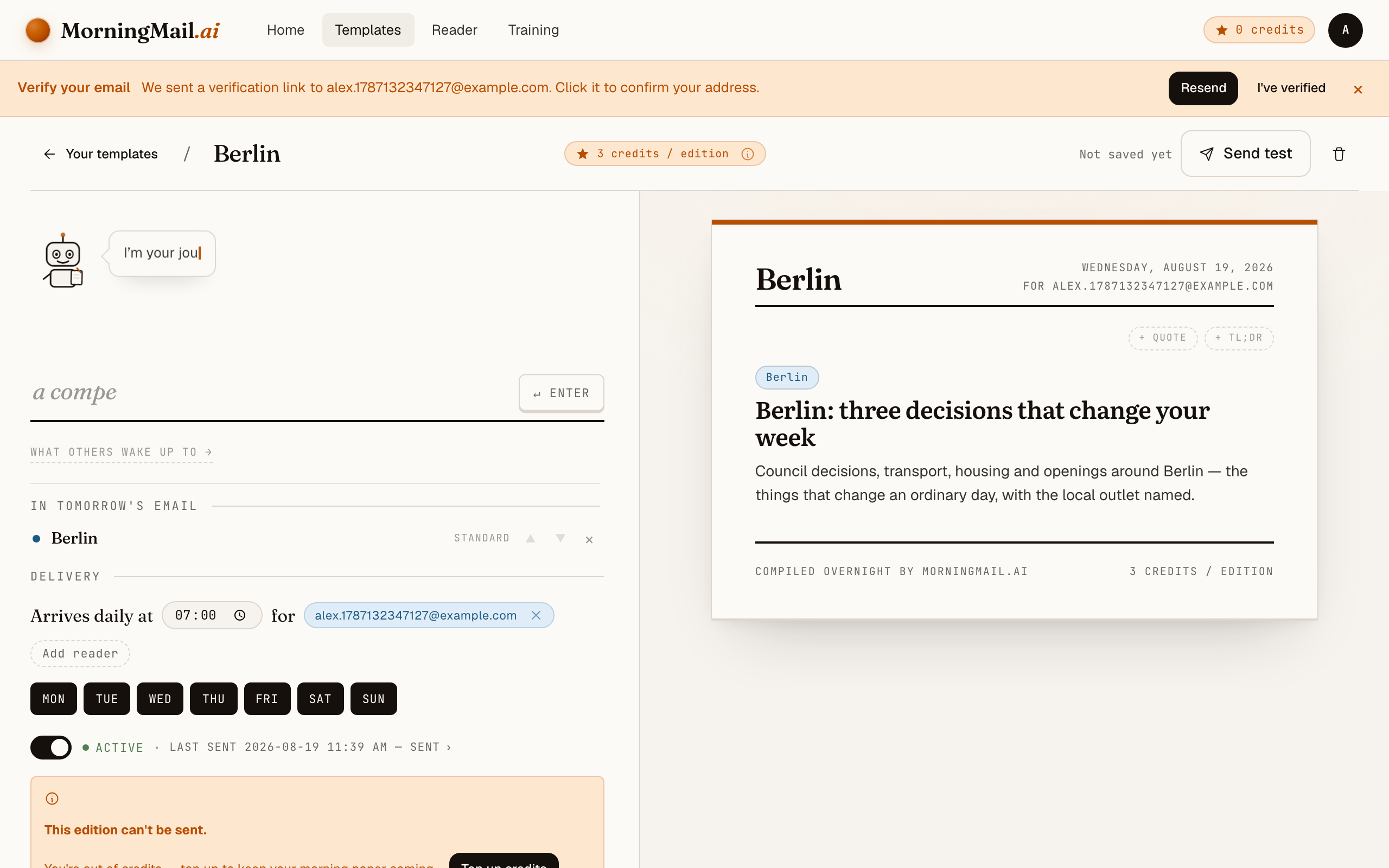
Everything else lives in the builder, once you have a paper to tune. Set the delivery time (07:00 by default) and which weekdays it runs, add readers — up to 100 — and add more topics the same way you added the first: by typing. Nothing here needs deciding on day one.
Get more out of your brief
- Name your competitors in the prompt
- "Notable fintech launches" gets you whatever was loudest; "any product, pricing or licensing news from Revolut, N26 and Wise" gets you a competitive-intelligence column. Named competitors are the highest-signal words you can give the agent.
- Separate regulation from market news with two sections
- A template can hold multiple news sections, each with its own prompt, length and tone. A dedicated regulatory section — PSD3, MiCA, EBA consultations — keeps compliance items from competing with funding gossip, and it reads better forwarded to legal.
- Ask for the 'so what' in one line
- Append "for each story, one sentence on the likely product impact" to your prompt. It's the sentence you'd write anyway when you paste the link into your team channel — let the agent draft it, and reading time becomes decision time.
- Set thresholds to keep funding noise out
- Fintech produces a seed round a day, and most are irrelevant to you. A constraint like "funding news only for payments infrastructure, and only from Series B" keeps the brief focused on moves that could actually reshape your market.
- Share the brief with your squad — or the gallery
- Templates support multiple recipients, so your designer and tech lead read the same three stories before planning. And if your section prompt turns out great, share it to the public community gallery for other fintech PMs to pick up 😊
Good sources to anchor your brief on
The agent searches the open web every morning and cites where it read things. These are the sources I'd point it at in your prompt:
- Finextra — The daily wire for banking and payments technology — announcements, partnerships and platform news across every fintech vertical, often straight from the institutions.
- Fintech Business Weekly — Jason Mikula's deeply reported analysis of BaaS, sponsor banking and fintech regulation — where partner-bank trouble tends to surface first.
- European Banking Authority (EBA) — The primary source for PSD3/PSR technical standards, consultations and guidelines — the paperwork that becomes your compliance backlog twelve months later.
- TechCrunch — Fintech — The fastest broad coverage of funding rounds, launches and shutdowns, with the strategy context that press releases leave out.
- Sifted — Fintech — The FT-backed outlet for European startups: neobank economics, market entries and the operator interviews that reveal roadmaps before they ship.
- Payments Dive — Focused trade coverage of the payments industry — interchange, networks, BNPL and regulation — written for practitioners rather than investors.
Frequently asked questions
- What's the price after the first free edition?
- The first edition is free and needs no credit card. After that, each send costs a few credits per section, depending on the AI model tier the section runs on. Credits never expire — buy once, use them at your own pace.
- How does this beat a Google Alert on 'fintech'?
- An alert on "fintech" is a daily avalanche of links you still have to read, rank and deduplicate. This brief arrives written: the agent searches fresh each morning, applies your priorities — regulation first, competitors by name — and delivers three paragraphs with sources underneath.
- Can it follow specific regulation like PSD3 or MiCA?
- Yes — name the frameworks in your prompt and the agent tracks consultations, technical standards and national transposition. Because it cites government sources directly, you can pull the actual document the moment something moves.
- Can I track named competitors?
- That's one of the strongest uses. List them in the prompt — "any launch, pricing change or licensing news from Revolut, N26, Wise" — and their moves land in your inbox the morning after they happen, announcement linked.
- Can my whole product squad get it?
- Yes. A template can have multiple recipients, so the squad reads the same brief before standup. Extra readers, the delivery time and the weekdays are all set afterwards, in your template's settings — daily for you, or a Monday-only edition if the team prefers a weekly pulse.
Your inbox, your editor
Build your own AI-written brief in two minutes. The first edition is on me — no credit card required.
Build your brief — freeI am always happy to answer questions and I'm open to feedback. Feel free to reach out at any time: marius@morningmail.ai