Signing you in...

Please wait while we verify your authentication

Article · Tuesday, October 13, 2026

AI developer tools · What shipped

For a senior engineer who already reads HN. Real changes in AI developer tools today: releases with version numbers, papers with benchmarks, repos that crossed a threshold worth knowing. Skip hype threads, pre-announcement leaks, and recycled summaries. Always link primary sources.

By Marius BongartsTech96 editions
← See today's latest
Editions
10 / 96
Generated by AI overnight from public sources, refreshed daily.
AI developer tools · What shipped
Tuesday, October 13, 2026
AI developer tools · What shipped

Claude Haiku 5.5 benchmarked; legal and taste agents ship evals

1 min read

Claude Haiku 5.5 evaluated

Anthropic's fastest model now has numbers attached.

Artificial Analysis ran Haiku 5.5 across ten benchmarks including GDPval, AutomationBench, and Terminal-Bench 4.0, measuring finance, legal, healthcare, engineering, and agentic capability [Source: Artificial Analysis]. The lineup includes five variants: Haiku 5.5 (Max) hits 43 on intelligence with 236 tokens/sec output speed, while Haiku 5.5 (Low) offers $0.02 per task pricing. Cost varies 8.7× across the family, letting teams pick their speed-versus-price tradeoff explicitly.

This fills the benchmark gap we noted five days ago.

Legal Agent Benchmark live

Harvey released a new test for agentic legal work.

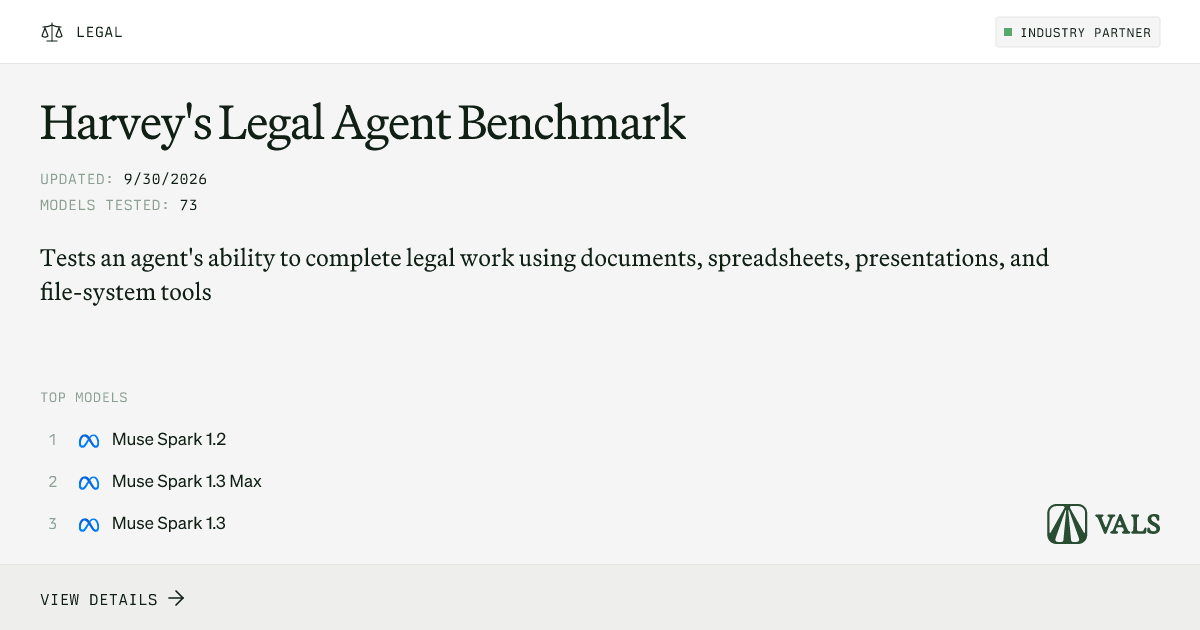
The Legal Agent Benchmark evaluates models using file tools, document readers, and bash commands across IP, M&A, data privacy, and banking domains [Source: Vals AI]. Muse Spark 1.2 leads overall with 25.42% task resolution, though Muse Spark 1.3 Max achieves 94.74% on criterion-level pass rate—revealing a gap between meeting criteria and solving entire tasks. Public and held-out test sets let builders validate before production.

Agent benchmarks are becoming domain-specific.

TasteVal and Humanity's Sixth Sense

Two new evals measure what frontier models actually understand.

P-Zero Research released TasteVal, benchmarking AI research taste across data curation, model training, and preference modeling; Opus 5.5 runs at 2.30× human efficiency [Source: Import AI]. Separately, Elorian and Scale AI shipped Humanity's Sixth Sense, a 522-question visual reasoning benchmark spanning images and video clips. GPT-6 Astra scores 53.6 against a 93.1 human baseline, while Chinese open-weight models trail significantly (GLM-5.3-flash: 26.8, Kimi K3: 25.5). The two benchmarks together measure both judgment and intuition.

Chinese and Western frontier models are now visibly stratified on vision reasoning.
Sources
Claude Haiku 5.5: Release Intelligence, Performance & Price
20 hours ago ... The Claude Haiku 5.5 release offers 5 models, each with different intelligence, performance ... AI Agents · Evaluations. Products. Optima · MicroEvals · Model ...
artificialanalysis.ai
AI Summary

Claude Haiku 5.5 was evaluated on Artificial Analysis Intelligence Index v4.3.2, which incorporates 10 benchmarks including AA-Briefcase v1.1, GDPval-AA v2.1, AutomationBench-AA, Terminal-Bench 4.0, SciCode, Humanity's Last Exam, GDP.pdf, CritPt, AA-Omniscience, and AA-LCR v1.1. The benchmark measures model performance across capability indices for Finance & Accounting, Strategy & Ops, Legal, Healthcare & Medical, Engineering, and Economics, alongside specific evaluations for agentic work, coding, document reasoning, physics, medical long-context reasoning, and software engineering tasks. Cost-per-task and output speed metrics are tracked across token types.

Visit source
Import AI 476: Creativity and RSI; worse-than-China open weight ...
17 hours ago ... AI startups Elorian and Scale AI have built and released Humanity's Sixth Sense, a benchmark that “measures how a model interprets and reasons through ...
importai.substack.com
AI Summary

AI startups Elorian and Scale AI released Humanity's Sixth Sense (HSS), a new benchmark measuring how models interpret visual scenes through intuitive reasoning. The benchmark contains 522 questions across 288 images and 234 video clips, testing temporal dynamics, physical logic, social understanding, and abstract inference. GPT-6 Astra achieved a pass@1 score of 53.6 compared to the human baseline of 93.1, while Chinese open-weight models performed significantly worse (GLM-5.3-flash scored 26.8, Kimi K3 scored 25.5). P-Zero Research released TasteVal, a benchmark evaluating AI systems' research taste across eight tasks including data curation, model training, and preference modeling. Frontier models' experimental research taste has doubled every three months since December 2025, with Opus 5.5 exceeding human baselines at 2.30x compute efficiency and roughly 1/30 of expert cost per attempt. Reflection announced Beam, a 501 billion parameter open-weight MoE model with 23 billion active parameters, optimized for token efficiency in reasoning and coding. Beam achieves comparable scores to GLM-5.2 while using 3-4x less inference compute, though benchmarks show it trails Chinese frontier models. The company plans to release model weights and technical artifacts later in October. Mistral announced Mistral Large 4, an open-weight model optimized for cybersecurity tasks, planned for release by month-end. Trained on 3,800 NVIDIA Grace Blackwell GPUs, ML4 will be the strongest Western open-weight model upon release, though Chinese models like GLM-5.3 and Kimi K3 maintain higher benchmark scores across most tasks.

Visit source
Harvey's Legal Agent Benchmark Leaderboard - Vals AI
5 hours ago ... Benchmark. The Legal Agent Benchmark is a benchmark recently released by Harvey to test the ability of models to support legal work in an agentic setting. There ...
vals.ai
AI Summary

Harvey released the Legal Agent Benchmark, a test for evaluating how AI models perform legal work in agentic settings using tools like file operations and bash commands across document types. Muse Spark 1.2 leads overall with a 25.42% task resolution score, while Muse Spark 1.3 Max achieves the highest criteria pass rate at 94.74%, revealing a significant gap between criterion-level performance and full task resolution. The benchmark includes two datasets (public and held-out test set) with task-specific evaluation across legal domains including intellectual property, M&A, data privacy, and banking.

Visit source
Compiled overnight by MorningMail.aiDelivered at 05:10 AM