AI developer tools · What shipped
For a senior engineer who already reads HN. Real changes in AI developer tools today: releases with version numbers, papers with benchmarks, repos that crossed a threshold worth knowing. Skip hype threads, pre-announcement leaks, and recycled summaries. Always link primary sources.
← See today's latestFable 5.1 holds lead; smaller models ship; KV cache compression arrives
Fable 5.1 & Mythos 5.1
Agentic coding just stayed cheap and got sharper.
Following previous issue, Fable 5.1 confirms its benchmarks and Mythos 5.1—the permissive-safeguard variant—ships with production-grade biotech capabilities [Source: Anthropic]. Mythos reaches 50% hit rate on protein binder design (versus 10–15% baseline) and delivers GPU kernel speedups up to 2.5× for genomics workloads, plus the model now runs high-resolution elevation mapping tasks that required specialized pipelines before. Both land with Enterprise Frontier Safeguards for zero-data-retention on-prem deployments.
Security and life sciences orgs now have first-class tooling.
Jan-Code-4B
Four billion parameters, local inference, beats bigger models.
Jan released Jan-Code-4B, a lightweight code model fine-tuned for consumer hardware that outperforms Jan's own prior 4B variant and Qwen3-4B-Instruct across three coding benchmarks: Aider (19.0 vs. 18.0), LiveCode Bench v6 (51.0 vs. 45.8), and AIME25 math reasoning (53.0 vs. 47.0) [Source: Jan.ai]. It runs on 8GB minimum RAM with quantized variants, ships OpenAI-compatible API access, and supports code generation, refactoring, debugging, and agentic workflows via vLLM or llama.cpp.
Local-first teams just cut cloud inference costs to zero.
MILO KV cache compression
Many-shot context just got 50% smaller in memory.
MILO, a block-wise low-rank KV cache compression framework published on arXiv, exploits redundancy in key-value caches to achieve up to 50% memory reduction and 1.8× throughput gain on Qwen2.5 models [Source: arXiv]. Dynamic rank allocation uses information entropy; system optimizations include fused Triton kernels and CUDA graphs. Benchmarks show the method outperforms prior baselines like ASVD and Palu by up to 4.5% accuracy on classification and reasoning tasks.
Long-context inference just crossed an efficiency inflection point.
Aikido Altar-1 security model
Pentesting model shrinks 78%, runs on four GPUs, stays sharp.
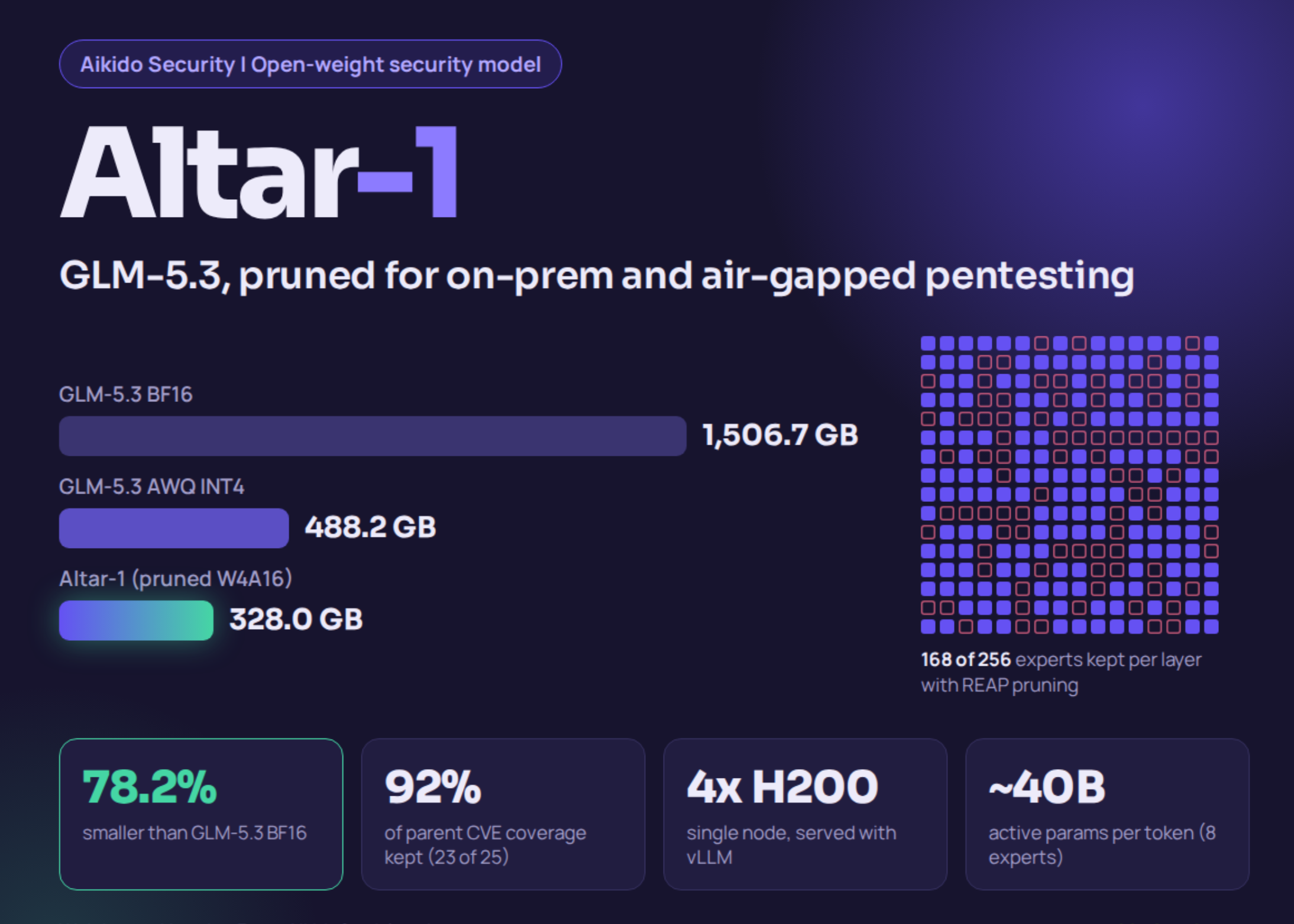
Aikido Security released Altar-1, a quantized and pruned variant of Z.AI's GLM-5.3 (753B) compressed from 1.51 TB to 328 GB while retaining 92% CVE coverage [Source: MarkTechPost]. It runs on a single 4× H200 node with 131k context length; weights are public on Hugging Face under the GLM-5.3 license. Recall on the internal 32-CVE benchmark sits at 60.4%, down negligibly from 65.6% on the full model.
Air-gapped security teams can now host frontier-class vulnerability detection locally.
 Introducing Claude Fable 5.1 and Claude Mythos 5.1 - Anthropic2 hours ago ... ... model releases. A small number of customers' custom integrations will then ... AI Act's Code of Practice on Transparency of AI-Generated Content. This ...anthropic.com
 MILO: Efficient Many-shot In-Context Learning with Block-wise Low ...20 hours ago ... Inference Optimization for Many-Shot ICL. Despite the promising results of ... Chen ShadowKV: kv cache in shadows for high-throughput long-context llm inference.arxiv.org
 Jan-Code-4B - Jan.ai16 hours ago ... Overview ; Parameters, 4B ; Base Model, Jan-v3-4B-base-instruct (Qwen3-4B-Instruct-2507) ; Fine-tuning focus, Code generation, editing, refactoring, debugging.jan.ai
 Aikido Security Releases Altar-1: An Open-Weight ... - MarkTechPost14 hours ago ... ... code --max-model-len 131072. vLLM selects the Marlin MoE kernel ... Altar-1 also powers Aikido Attack, AI Code Analysis, and Deep Review. Next ...marktechpost.com