AI developer tools · What shipped
For a senior engineer who already reads HN. Real changes in AI developer tools today: releases with version numbers, papers with benchmarks, repos that crossed a threshold worth knowing. Skip hype threads, pre-announcement leaks, and recycled summaries. Always link primary sources.
← See today's latestLFM2.5 draft models 3x faster, Router slashes inference costs 40%
Liquid AI: LFM2.5 DSpark draft models
Speculative decoding speeds up token generation threefold.
Liquid AI shipped DSpark draft model checkpoints for LFM2.5 (1.2B-Instruct, 2.6B, and 8B-A1B), enabling 3.18x faster decoding on H100 GPUs and 2.87x on M4 Max MacBooks while preserving exact greedy output [Quelle: MarkTechPost]. Each ~300M-parameter drafter proposes nine tokens verified in one forward pass; day-one support landed in llama.cpp and SGLang. Speedup varies by workload—agentic scenarios see 57% latency cuts on the 2.6B model, while on-device MoE gains only 1.18x.
Weights ship free under LFM Open License for sub-$10M entities.
Ramp Router: unified inference API
One endpoint routes requests to the cheapest viable model.
Ramp launched Router.com, a unified API that automatically routes AI inference to the lowest-cost model meeting performance requirements, cutting costs by 40% on average [Quelle: FFNews]. The platform connects to OpenAI, Anthropic, and SpaceX, with Gemini and open-source models (DeepSeek, Qwen, Kimi) coming via Fireworks AI. Over 100 internal optimizations—model selection, caching, compression—plus automatic fallback ensure 99.9%+ reliability even as model portfolios shift.
Free through 2026; new users get $26 credits on standard token rates.
Vectris Waveform: GPU compute recovery
Structural waste inside GPUs is recoverable without retraining.
Vectris Labs announced Waveform, a control plane that surfaces untapped capacity within deployed H100, H200, and B200 GPUs through real-time optimization [Quelle: PRNewswire]. On Mistral inference workloads, the system achieved 30–73% higher throughput, 51–56% energy cuts, and 22–42% faster completion—plus 67% energy savings on Intel silicon using MLPerf LoadGen. The layer sits between existing stacks and inference kernels, requiring no model changes.
Launch scheduled October 1, 2026; design partners get early access.
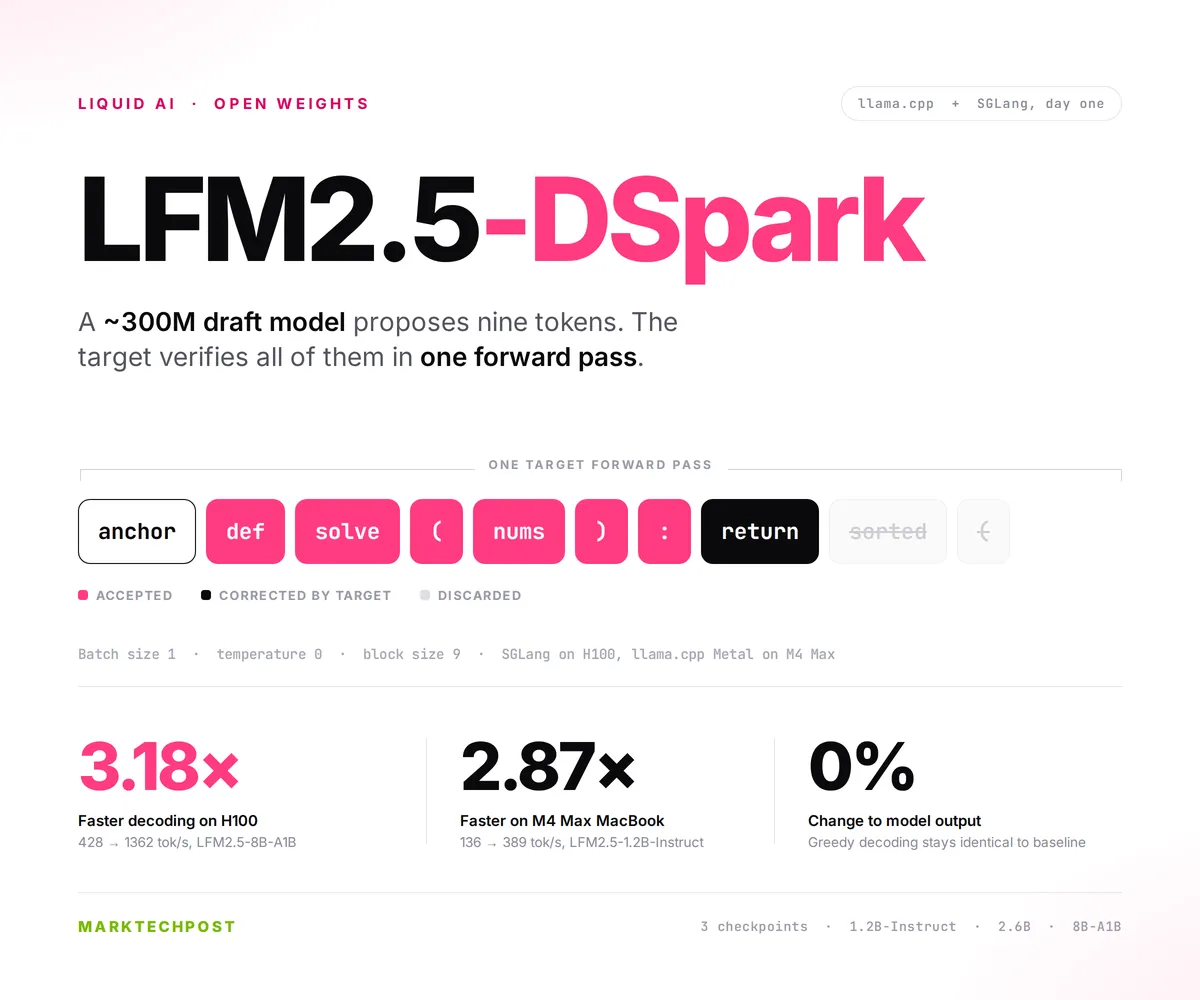 Liquid AI Releases LFM2.5-DSpark Draft Models That Deliver Up to ...10 hours ago ... Is it deployable? Yes, if you self-host. The weights ship as Safetensors and GGUF, and the drafter checkpoints are not served by any hosted inference provider ...marktechpost.com
 Ramp Launches Router.com to Slash Corporate AI Inference Costs ...10 hours ago ... ... optimizations across model selection, caching, compression, timing, and request handling. Developers no longer have to keep up with every model release.ffnews.com
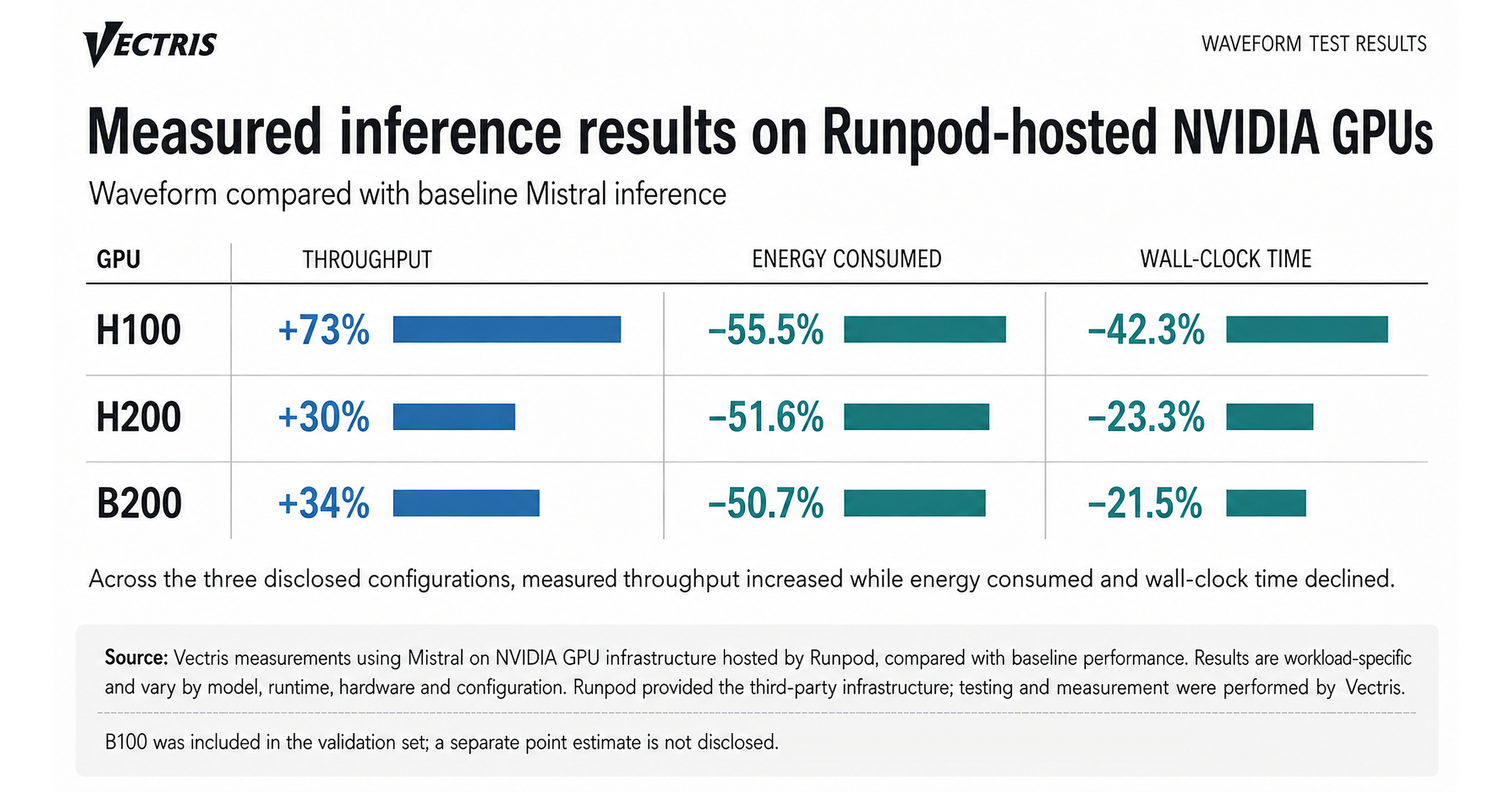 Vectris Discovers Recoverable AI Compute Capacity Inside ...18 hours ago ... ... AI output—without retraining models, changing model weights or modifying GPU kernels. ... It does not replace the optimized inference stack; it adds a control ...prnewswire.com