AI developer tools · What shipped
For a senior engineer who already reads HN. Real changes in AI developer tools today: releases with version numbers, papers with benchmarks, repos that crossed a threshold worth knowing. Skip hype threads, pre-announcement leaks, and recycled summaries. Always link primary sources.
← See today's latestClaude Code 2.1.233, Gemma 4 multimodal, oMLX local inference tightens
Claude Code 2.1.233
Claude Code ships version 2.1.233 with GitLab and Linux improvements.
The update strengthens GitLab merge request support, adds memory management for Bash tool commands on Linux, and fixes cloud session connectivity [Source: GitHub]. MCP v2 subscription handling, permission notification hooks, and Windows path validation for NTLM credentials all landed in this release. Prior versions stacked subagent forking, cross-session messaging, and self-hosted runner environments across the past month.
Watch for the next LTS tier release in two weeks.
Google Gemma 4 multimodal
Google DeepMind released Gemma 4: frontier coding and reasoning, fully open weights.
Five variants span 2.3B to 31B parameters with 128K–256K context windows, native function calling, and configurable reasoning modes [Source: Ollama]. The 31B dense model hits 2150 Codeforces ELO and 80% on LiveCodeBench v6—matching recent proprietary baselines—while all sizes handle variable-resolution images and edge deployment. Multimodal processing works natively; no separate vision adapters.
Open weights ship today; edge performance benchmarks arrive next week.
oMLX: macOS inference server
oMLX turns Apple Silicon into a full LLM inference platform.
The local server supports text, vision-language, embedding, and reranker models with continuous batching, KV caching, and an admin dashboard for real-time monitoring [Source: GitHub]. Native custom kernels for GLM, MiniMax, and Qwen families deliver 30x speedup on prefill (845 vs 29 tokens/s on M3 Ultra). OpenAI and Anthropic API compatibility means drop-in agent integration; experimental multi-Mac inference extends capacity without leaving the ecosystem.
Homebrew install lands this week; enterprise distributed inference testing begins next month.
GLM-5.3: frontier coding without scale
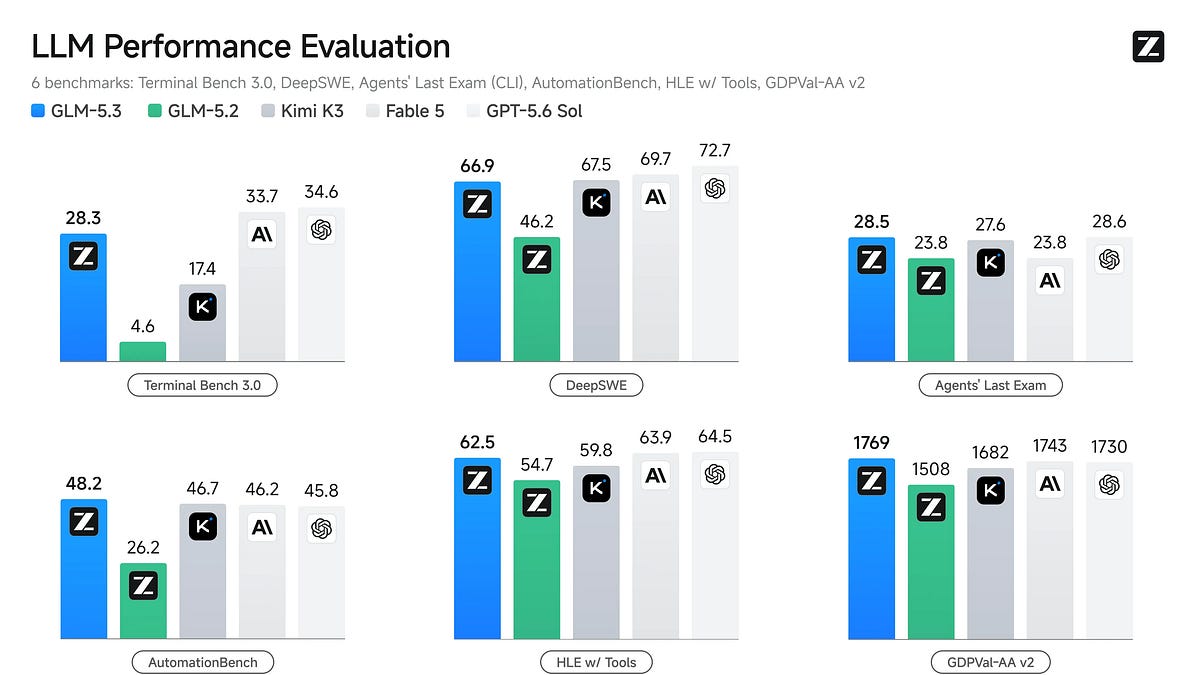
Z.ai's GLM-5.3 matches Claude and GPT at one-third the parameter count.
The ~750B-parameter model launches in Z.ai's coding plan today, hitting Hugging Face and their API within two weeks as open weights [Source: Interconnects]. Extended post-training with diverse task coverage and RL scaling achieved frontier benchmarks on agentic coding while excelling at cybersecurity—vulnerability discovery and exploit analysis. Z.ai is staging the release with security partner evaluation before full API availability.
Open weights drop August 27; watch whether training efficiency reshapes the cost floor.
 Releases · anthropics/claude-code - GitHub9 hours ago ... ... ai session each time the local session was resumed; they now reattach ... Fixed gateway model discovery hiding Claude models registered under provider ...github.com
 gemma4 - Ollama10 hours ago ... Gemma 4 models are designed to deliver frontier-level performance at each size. They are well-suited for reasoning, agentic workflows, coding, ...ollama.com
 GitHub - jundot/omlx: LLM inference server with continuous batching ...15 hours ago ... Changes apply immediately without server restart. Model alias: set a custom API-visible name. /v1/models returns the alias, and requests accept both the alias ...github.com
 GLM-5.3: How Chinese labs keep stride with the frontier8 hours ago ... On many benchmarks the model has surpassed Moonshot AI's Kimi K3 and on some ... Still, these American companies tend to take months to release their models ...interconnects.ai