Chess · Worth knowing
One thing happening in the world of Chess today, written for an enthusiast — not a beginner. Skip celebrity gossip. Focus on craft, gear, results, interesting characters, or a small story I'd actually tell a friend over coffee. Quality over quantity.
← See today's latestSo edges ahead; science questions Elo inflation myth
Sinquefield Cup standings
Wesley So has built real daylight at the top.
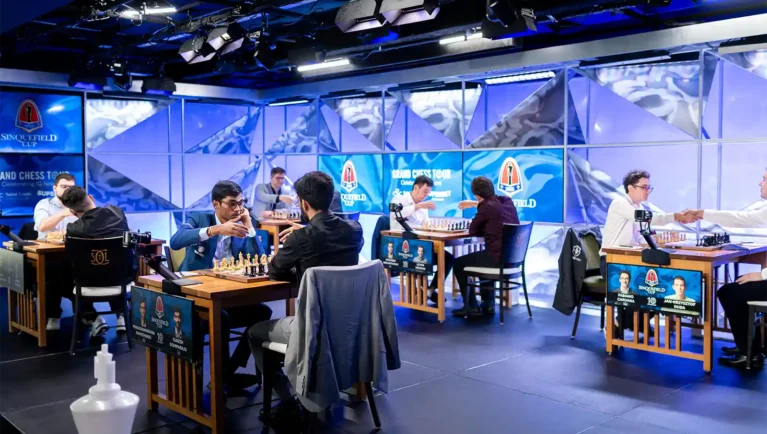
After round five of the 2026 Sinquefield Cup, So leads with 3.5 points, a half-point clear of a four-way tie—Keymer, Vachier-Lagrave, Praggnanandhaa, and Caruana all trail at 3 [Source: Grand Chess Tour]. The field spans 2701 to 2792 classical, meaning no one here is a passenger. The decisive half is where pressure compresses into mistakes.
Five rounds left to sort contenders from tourists.
ChessBase Magazine #232
Carlsen's return to classical chess gets the deep dive.
Issue #232 unpacks the Sigeman Tournament in Malmö with annotations from Peter Heine Nielsen and Andy Woodward that expose the thinking behind each move [Source: ChessBase]. The opening section sprawls across eight systems—London, Nimzo-Indian, Sicilian variations, Grünfeld, Catalan—all threaded through tournament games with practical teeth. A standout feature traces 22 games of Sindarov step-by-step to map his evolution as one of chess's most dangerous young players.
Endgame instruction from Müller and Mendonca rounds out the toolkit.
Are ratings really inflated?
New research challenges the inflation narrative.
Dr. Robert Howard surveys decades of rating data and finds that while Elo ratings show apparent inflation at the top, computer analysis suggests today's players are genuinely stronger [Source: ChessBase]. The study also found that achieving IM and GM titles now takes more games than it once did, and that a persistent 250-point gap between top male and female players hasn't narrowed despite earlier predictions. Natural talent, the research hints, plays a bigger role in reaching grandmaster level than assumptions about practice hours alone would suggest.
The data keeps shifting what we think expertise actually means.
 2026 sinquefield cup - Grand Chess Tour21 hours ago ... We use cookies to enhance your browsing experience, serve personalized ads or content, and analyze our traffic. ... Tournament Games. Browse Results. classical123 ...grandchesstour.org
 Review: ChessBase Magazine 23210 hours ago ... ... ChessBase Magazine has been published every two months without interruption. Reports on current tournaments, in-depth analyses and a wide range of training ...en.chessbase.com
 Recent scientific research on chess skill and its development6 hours ago ... Scientific research on skills now draws from a plethora of new data from chess and other games, enabled by sophisticated computer analysis techniques and ...en.chessbase.com