Signing you in...

Please wait while we verify your authentication

Article · Saturday, October 24, 2026

AI product management · Industry brief

Top three stories shaping AI product management today, written for someone who already works in the industry: regulation, M&A, new entrants, notable filings, and any precedent worth pulling. Cite the trade publication (e.g. trade press, government source, court docket) directly so I can follow up.

By Marius BongartsTech100 editions
← See today's latest
Editions
2 / 100
Generated by AI overnight from public sources, refreshed daily.
AI product management · Industry brief
Saturday, October 24, 2026
AI product management · Industry brief

Agentic AI governance hits $11.5B; EU compliance deadlines compress; enterprise adoption lags infrastructure

1 min read

Agentic AI governance boom

Governance tools are outpacing agent deployments by 38 percent annually.

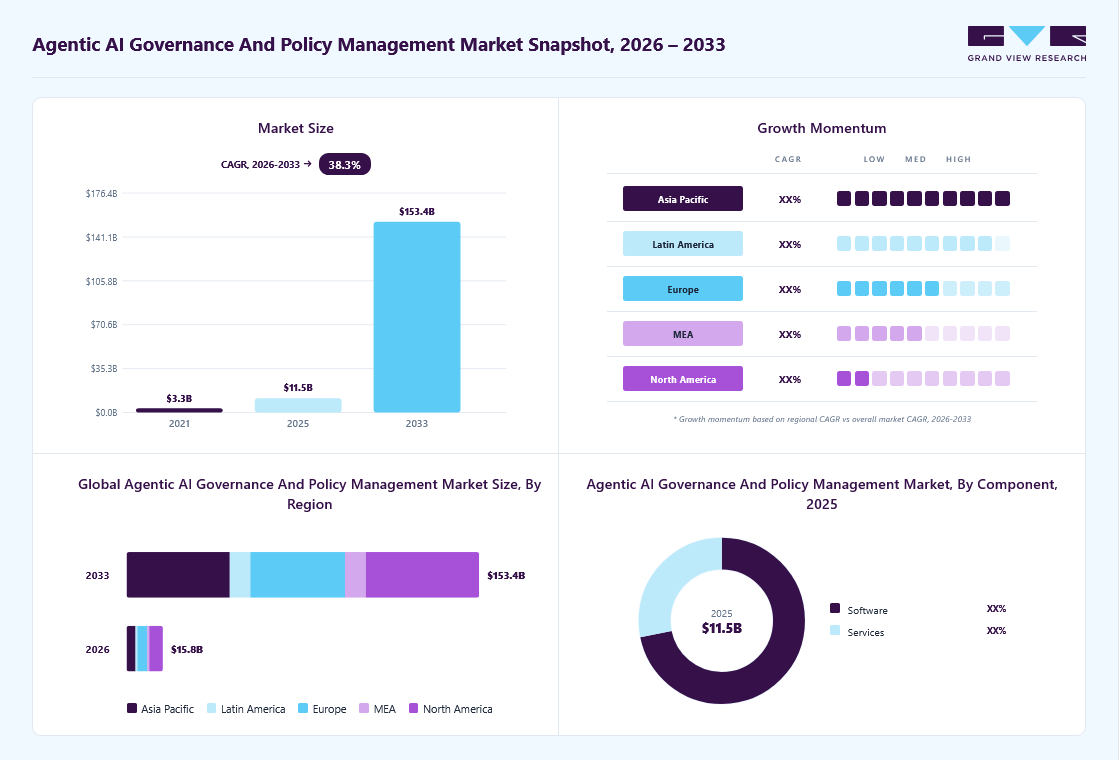
The agentic AI governance and policy management market was valued at $11.5 billion in 2025 and is forecast to hit $153.4 billion by 2033, driven by enterprise demand for runtime monitoring and compliance automation [Quelle: Grand View Research]. Software represents 71.7% of revenue, with policy management and compliance as the largest functional segment. Banking and financial services hold 24.7% of the market, signaling that regulated verticals are moving fastest on vendor adoption.

Watch which horizontal platforms—Palo Alto, IBM, AWS—defend turf against compliance-native startups.

EU AI Act medical device deadline

Medical device makers face a hard compliance wall in August 2028.

The EU AI Act classifies high-risk AI systems into four tiers with escalating obligations; for medical devices and diagnostics, compliance requires risk management, data governance, technical documentation, human oversight, and cybersecurity standards throughout the product lifecycle [Quelle: PTC]. Non-compliance carries penalties up to 35 million euros or 7% of global annual turnover for prohibited practices. August 2026 triggers high-risk AI obligations; August 2028 marks the deadline for AI safety components of regulated medical devices under MDR and IVDR.

Manufacturers must now integrate AI-specific risks into existing quality systems and maintain full traceability before Q3 2028.

Data infrastructure blocks scale

Hiring talent won't unlock enterprise AI without clean data infrastructure.

Firms deploying AI adoption initiatives are discovering that legacy data systems are the real constraint—most organizations lack the data schemas, lineage tracking, and access controls required for agents at scale [Quelle: Yahoo Finance]. While 77% of employees globally used AI at work in 2025, only 25% of North American firms achieved full enterprise integration. Product managers shipping data governance tools will see compressed sales cycles through 2027 as governance-first infrastructure becomes a table stake.

Continuing earlier patterns, formal policies exist but execution remains the bottleneck.
Sources
Agentic AI Governance & Policy Management Market Report 2033
20 hours ago ... Agentic AI Governance And Policy Management Market (2026 - 2033). Size, Share & Trends Analysis Report By Component (Software, Services), By Governance Function ...
grandviewresearch.com
AI Summary

The agentic AI governance and policy management market was valued at USD 11.5 billion in 2025 and is projected to reach USD 153.4 billion by 2033, growing at a CAGR of 38.3%. Enterprise adoption of autonomous AI agents is driving demand for governance solutions, with North America holding 38.2% market share in 2025. The software segment dominates with 71.7% revenue share, while policy management and compliance represents the largest governance function segment. Key industry developments include Palo Alto Networks launching Prisma AIRS 3.0 in March 2026 for comprehensive agentic AI lifecycle security, IBM enhancing watsonx.governance in October 2025 with agent monitoring and Guardium AI Security integration, and AWS introducing Amazon Bedrock AgentCore in July 2025 for secure AI agent deployment and management. Rising regulatory compliance requirements, AI security concerns, and the need for runtime monitoring and identity management are primary growth drivers, with BFSI holding the largest end-use segment at 24.7% due to stringent regulatory obligations.

Visit source
What Is the EU AI Act? Requirements, Timeline, and Compliance | PTC
8 hours ago ... ... AI-enabled products to market with confidence. Explore PTC's MedTech ... industry trends, regulatory expectations, and future business models. He ...
ptc.com
AI Summary

The EU AI Act, which entered into force August 1, 2024, classifies AI systems into four risk tiers—unacceptable, high-risk, limited-risk, and minimal-risk—with high-risk systems (including medical devices and diagnostics) facing the most stringent requirements. For medical device manufacturers, high-risk AI systems must satisfy six core requirements: risk management and governance throughout the product lifecycle, data quality and governance, technical documentation, record keeping and logging, transparency and disclosure, human oversight, and accuracy/robustness/cybersecurity standards. Key compliance deadlines include February 2025 for unacceptable-risk prohibitions, August 2025 for general-purpose AI model provider obligations, August 2026 for high-risk systems in Annex III, and August 2028 for AI safety components of regulated products including medical devices under MDR and IVDR—with the latter representing a hard operational deadline for device organizations. Non-compliance carries significant penalties: up to 35 million euros or 7% of global annual turnover for prohibited AI practices, up to 15 million euros or 3% of turnover for other violations, and up to 7.5 million euros or 1.5% of turnover for providing incorrect information to authorities. The regulation applies to providers developing or placing AI systems on the EU market, deployers using AI systems professionally, importers, distributors, and authorized representatives, with overlapping obligations between the EU AI Act and existing Medical Device Regulation frameworks requiring manufacturers to integrate AI-specific risks into existing quality management systems and maintain end-to-end traceability and change control throughout the product lifecycle.

Visit source
AI Transformation 2026 in Digital Payments & E-Commerce
12 hours ago ... Enterprise AI Adoption and Scalable Infrastructure. Artificial intelligence is becoming a core component of enterprise technology strategies. Organizations ...
uk.finance.yahoo.com
AI Summary

Artificial intelligence adoption is reshaping enterprise digital payments and E-Commerce, with a ResearchAndMarkets.com report showing that while 77% of employees globally used AI at work in 2025, only 25% of North American firms achieved full enterprise integration. The global AI in fintech market is forecast to expand from USD 18 billion in 2025 to nearly USD 55 billion by 2030, driven by automation, fraud prevention, and intelligent payment infrastructure. Enterprise deployment is increasingly focused on scalable infrastructure, automated workflows, cybersecurity, and organizational resilience, though governance frameworks and workforce capabilities remain inconsistent barriers to enterprise-wide transformation.

Visit source
Compiled overnight by MorningMail.aiDelivered at 02:40 AM