AI product management · Industry brief
Top three stories shaping AI product management today, written for someone who already works in the industry: regulation, M&A, new entrants, notable filings, and any precedent worth pulling. Cite the trade publication (e.g. trade press, government source, court docket) directly so I can follow up.
← See today's latestFTC preemption clash, compliance M&A surge, governance enforcement hardens
FTC preemption creates compliance trap
The FTC just weaponized disclosure against state law compliance.
On July 7, 2026, the FTC published a policy statement declaring that companies modifying AI outputs to comply with state laws like Colorado's AI Act without prominent disclosure may violate Section 5 of the FTC Act as deceptive practices [Quelle: Eversheds Sutherland]. The enforcement framework applies deception tests to undisclosed output steering—including bias mitigation, equity adjustments, and accuracy suppression—covering foundation model developers, app builders, and enterprise users. This forces a brutal choice: comply with state law and risk federal liability, disclose the modification and undermine product value, or find a disclosure standard that survives both regimes.
Comments close July 31, 2026 (FTC Docket FTC-2026-0859)—but the real battle is product strategy.
Compliance consolidation accelerates
Compliance startups are becoming acquisition targets at scale.
Assent completed its acquisition of IPOINT in July 2026, merging AI-powered product compliance with lifecycle assessment and material intelligence to help manufacturers navigate EU Battery Passports and the Ecodesign for Sustainable Products Regulation [Quelle: IPOINT]. In the same window, 3E acquired Yordas Group, adding REACH registration services and regulatory content expertise across chemical management, product stewardship, and sustainability to extend 3E's footprint into cosmetics, automotive, and polymers [Quelle: 3E]. Both deals reflect acquirer pressure to bundle regulatory content, intake automation, and AI-driven evidence generation into single platforms.
Watch whether hyperscalers next move to acquire end-to-end compliance orchestration.
Runtime enforcement becomes infrastructure
Static governance repositories are becoming liability.
Gartner's recent reports position AI governance platforms as distinct infrastructure requiring real-time runtime enforcement rather than post-deployment audits [Quelle: Kong]. No single vendor governs AI end-to-end; instead, organizations must compose capabilities across multiple platforms including AI gateways for traffic-level policy enforcement. Gartner expects AI security and governance to fully converge within two years, particularly around agentic AI where autonomous systems can trigger irreversible downstream actions. Runtime enforcement at the infrastructure layer is now critical for compliance and risk management.
Procurement teams are already tightening third-party AI intake requirements against runtime enforcement benchmarks.
Pentagon's AI mandate faces budget squeeze
Ambition collides with fiscal constraints.
The White House issued executive orders in June requiring rapid AI adoption across the U.S. government and national security enterprise, anchored by adoption, adaptation, assurance, and accountability [Quelle: War on the Rocks]. The $87.6 billion emergency budget supplemental includes $5.1 billion for cybersecurity and autonomy but lacks dedicated funding for the AI software mandated by the directives. Command-level AI software is purchased through operations and maintenance accounts strained by $34–42 billion in Iran operations costs, forcing military services to cut training and maintenance. Without explicit line-item funding or executive action to reprogram FY2026 reconciliation funds before September 30, AI software adoption risks being deprioritized against competing operational needs.
Commercial solutions are ready; the blocker is now budget authority.
 FTC's policy statement on “suppression of accuracy” in AI systems ...6 hours ago ... ... AI system deprioritizes accuracy to achieve other goals may undermine your product's ... AI liability laws and this proposed federal enforcement position.eversheds-sutherland.com
 AI Governance Platforms: Why Runtime Enforcement Matters7 hours ago ... Gartner says no single vendor can govern AI alone. AI governance platforms define AI policy, but enforcement happens at the connectivity layer.konghq.com
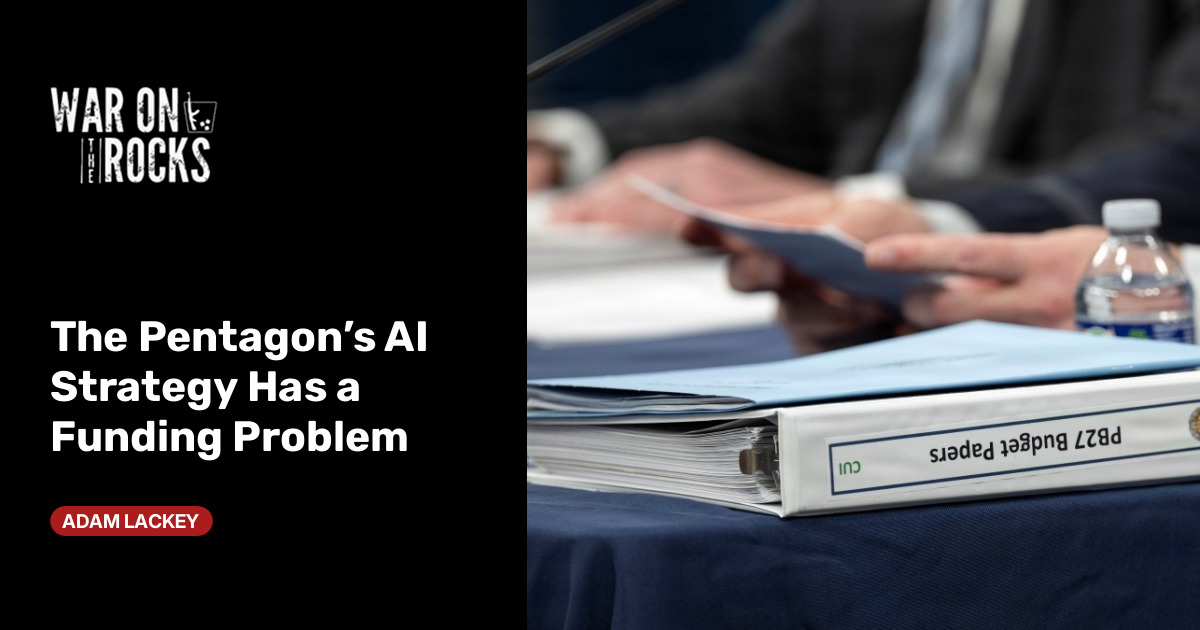 The Pentagon's AI Strategy Has a Funding Problem19 hours ago ... Three days later, National Security Presidential Memorandum 11 directed every element of the national security enterprise to accelerate AI adoption, anchored by ...warontherocks.com
 Assent Acquires IPOINT, Uniting AI-Powered Compliance and ...10 hours ago ... ... product regulation. Perhaps most compelling, the combined ... Assent is the global leader in supply chain sustainability management and product compliance ...ipoint-systems.com
 3E Acquires Yordas Group: Expanding Leadership in Product ...19 hours ago ... ... AI compliance solutions for ... regulatory content services across chemical management, product stewardship, sustainability, and regulatory compliance.via.ritzau.dk