Signing you in...

Please wait while we verify your authentication

Article · Saturday, October 17, 2026

AI product management · Industry brief

Top three stories shaping AI product management today, written for someone who already works in the industry: regulation, M&A, new entrants, notable filings, and any precedent worth pulling. Cite the trade publication (e.g. trade press, government source, court docket) directly so I can follow up.

By Marius BongartsTech97 editions
← See today's latest
Editions
6 / 97
Generated by AI overnight from public sources, refreshed daily.
AI product management · Industry brief
Saturday, October 17, 2026
AI product management · Industry brief

Assurance schemes launch; shadow AI market hits $8.7B by 2033

2 min read

Third-party AI assurance

Independent testing is becoming the compliance table stakes.

The British Standards Institution launched three AI conformity assessment schemes in October targeting high-risk biometrics, large language model applications, and enterprise AI risk management—addressing demand from enterprises where only 25 percent of business leaders currently have formal AI governance programs [Quelle: Biometric Update]. BSI is piloting biometric conformity assessment aligned with EU AI Act Annex VII procedures and seeking Notified Body designation. Competing assessment providers—DEKRA, SGS, TÜV SÜD, TÜV Rheinland—are already accredited or pursuing designation, fragmenting the market into mandatory third-party conformity assessment for high-risk systems and voluntary certifications for procurement and due diligence.

Watch whether assessment standards converge or splinter by region.

Shadow AI governance market

The market for unauthorized AI detection just hit escape velocity.

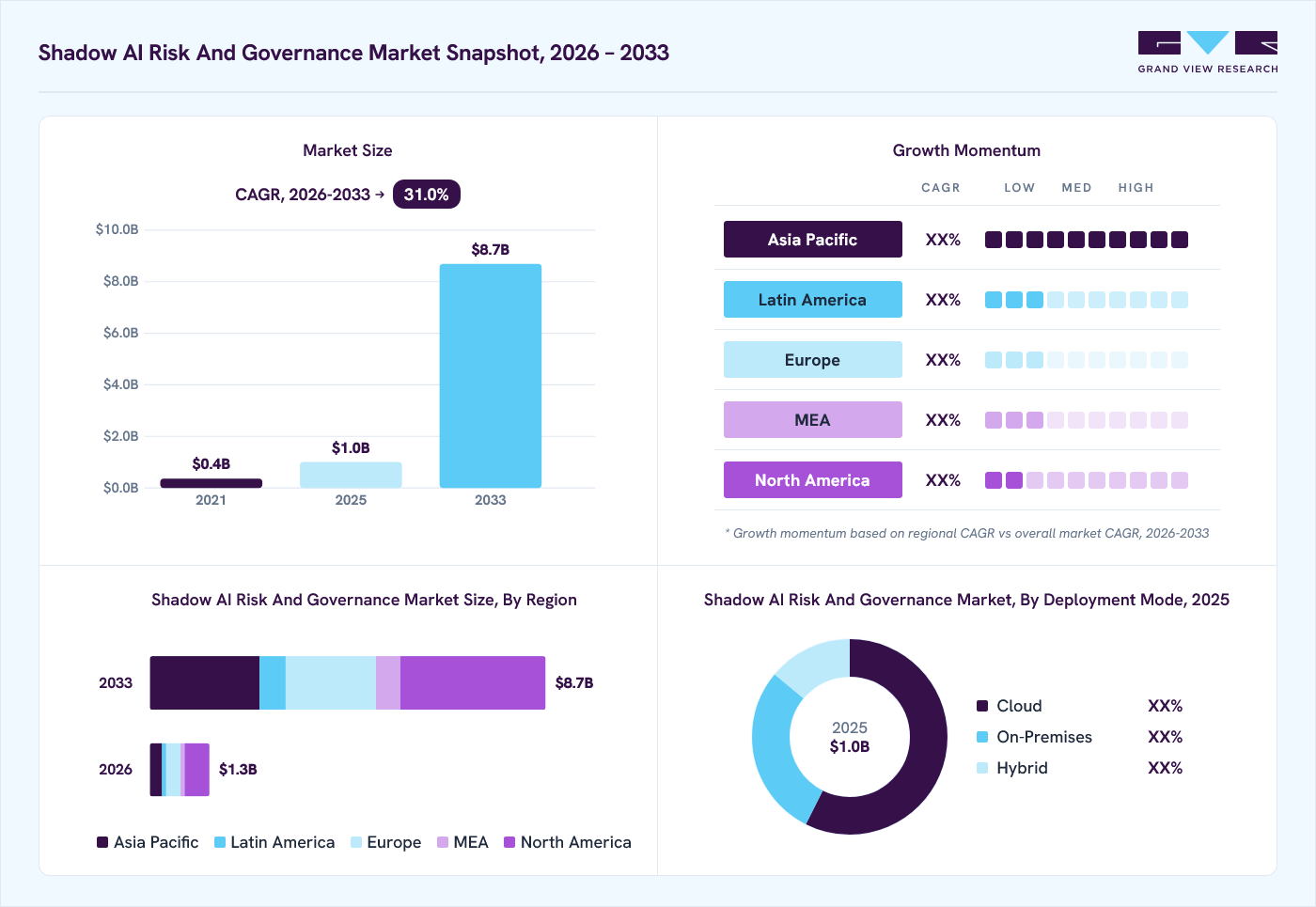
Global shadow AI risk and governance will grow from $1.3 billion in 2026 to $8.7 billion by 2033—a 31 percent compound annual growth rate driven by enterprises needing visibility into unsanctioned tools and formalized AI governance frameworks [Quelle: Grand View Research]. North America leads with 42.3 percent of revenue; Asia-Pacific is scaling fastest. Shadow AI Discovery and Visibility held 26.2 percent market share in 2025, with recent launches from Cisco (June 2026), SailPoint (March 2026), and BigID–AWS partnerships signaling consolidation among large technology providers.

Expect M&A velocity to spike as specialized vendors face pressure from integrated players.

State banking AI supervision

U.S. state regulators just published their AI playbook.

The Conference of State Bank Supervisors released a principles-based AI Supervisory Framework grounded in NIST and Cyber Risk Institute standards to help state-chartered banks and nonbank financial institutions assess AI risk and prepare for examinations [Quelle: EideBalley]. The framework covers governance, AI inventories, generative AI use cases, third-party vendor risk, model risk, and consumer protection. Individual state adoption will vary—institutions must monitor their own regulators' guidance as it develops.

This creates a patchwork; vendors serving state-chartered banks will need 50+ compliance playbooks.

Open-weight model risk framework

Open-source models now have a shared risk language.

Microsoft and NVIDIA published a joint framework grounding open-weight model risk assessment in ISO standards and the NIST AI Risk Management Framework, introducing a five-category taxonomy spanning Cybersecurity, Data Protection, Content, Human-AI Interaction, and Bias [Quelle: Microsoft Security Blog]. The guidance maps risks to controls across model, inference, application, and operational layers—emphasizing that weight openness alone does not determine risk. Future extensions will cover runtime and application-layer protections with a joint repository for shared evaluation resources.

This standardization signals that enterprises now demand vendor-neutral governance, not lock-in through proprietary frameworks.

Sources
BSI launches AI assurance schemes spanning biometrics, LLMs and ...
9 hours ago ... The AI Risk Management Assessment is based on the NIST AI Risk Management Framework and ISO/IEC 23894. It targets products that do not require mandatory third- ...
biometricupdate.com
AI Summary

The British Standards Institution launched three AI assessment schemes in October 2024 targeting high-risk biometric systems under the EU AI Act, large language model applications, and product-level AI risk management. The schemes address growing market demand for independent validation of AI safety and reliability, with BSI research showing only 25 percent of business leaders have formal AI governance programs. BSI is piloting the biometric conformity assessment while working toward designation as an EU AI Act Notified Body, following Annex VII procedures for technical documentation and quality management review. The product-level assessment uses the NIST AI Risk Management Framework and ISO/IEC 23894 standards. Competing assessment services are expanding in the market, including DEKRA (accredited by the Dutch Accreditation Council for biometric AI conformity assessment), SGS, TÜV SÜD, TÜV Rheinland, and others offering gap analysis, technical testing, and voluntary certifications. These services serve different purposes: mandatory third-party conformity assessment is required for certain high-risk systems under the EU AI Act to achieve market access, while voluntary assessments support procurement, due diligence, and governance decisions for other AI products.

Visit source
Shadow AI Risk And Governance Market Report, 2026-2033
18 hours ago ... This growing focus on protecting sensitive data is driving the adoption of AI data security and governance solutions, supporting the growth of the shadow AI ...
grandviewresearch.com
AI Summary

The global shadow AI risk and governance market was valued at USD 1.0 billion in 2025 and is projected to reach USD 8.7 billion by 2033, growing at a CAGR of 31.0% from 2026-2033. North America leads with 42.3% revenue share in 2025, while Asia Pacific is the fastest-growing region. The market is driven by organizations' need for visibility into unauthorized AI tools, data protection, and AI governance frameworks as enterprises expand AI adoption across business functions. Shadow AI Discovery & Visibility held the largest segment share at 26.2% in 2025, with cloud deployment and large enterprises dominating adoption. Growing regulatory requirements around AI governance are encouraging companies to formalize AI governance frameworks and strengthen oversight of AI-related risks. Key recent developments include Cisco Systems launching Cisco Cloud Control in June 2026 for unified AI agent management and governance, and expanding Cisco AI Defense in February 2026 with AI supply chain governance capabilities. BigID collaborated with Amazon Web Services in May 2025 as a launch partner for AWS's Data & AI Governance and Security initiative. SailPoint Technologies launched Shadow AI Remediation in March 2026 to detect unauthorized AI tools and prevent sensitive data uploads. The market remains moderately fragmented with competition among large technology providers (Cisco, Microsoft, Palo Alto Networks) and specialized vendors (Credo.AI, BigID, SailPoint).

Visit source
CSBS Releases AI Supervisory Framework for Financial Institutions
6 hours ago ... The Cyber Risk Institute Financial Services AI Risk Management Framework; The ... AI-based products, services, and tools. Within those organizations ...
eidebailly.com
AI Summary

The Conference of State Bank Supervisors (CSBS) released a principles-based Artificial Intelligence Supervisory Framework designed to help state examiners assess AI use and associated risks at state-chartered banks and state-licensed nonbank financial institutions. The framework, based on resources from the National Institute of Standards and Technology, Cyber Risk Institute, and U.S. Department of the Treasury, includes guidance on governance and oversight, AI inventories, generative AI use cases, third-party vendor risk, model risk, and consumer protection. Financial institutions can use the framework to evaluate their AI programs, strengthen governance and risk management practices, and prepare for state examinations, though adoption will be determined individually by each state regulatory agency, so institutions should monitor state-specific supervisory guidance as it develops.

Visit source
Managing open-weight model risk in enterprise deployments
11 hours ago ... ... AI Risk Management Framework. The paper reflects a core idea: weight openness alone does not determine an AI system's risk. Risk depends on the model, use ...
microsoft.com
AI Summary

Microsoft and NVIDIA published "Risk Management for Open-Weight Models in Enterprise," a joint framework grounded in ISO standards and the NIST AI Risk Management Framework to help enterprises assess and manage risks when deploying open-weight AI models. The paper introduces a shared risk taxonomy organized into five categories—Cybersecurity, Data Protection, Content, Human-AI Interaction, and Bias—and maps evaluations to specific risks, emphasizing that weight openness alone does not determine an AI system's risk; rather, risk depends on the model, use case, deployment context, and implemented safeguards. The guidance connects identified risks to controls that can operate across model, inference, application, and operational layers, with plans for future extensions across runtime and application layers and a joint repository for shared evaluation resources.

Visit source
Compiled overnight by MorningMail.aiDelivered at 02:40 AM