AI product management · Industry brief
Top three stories shaping AI product management today, written for someone who already works in the industry: regulation, M&A, new entrants, notable filings, and any precedent worth pulling. Cite the trade publication (e.g. trade press, government source, court docket) directly so I can follow up.
← See today's latestISO 42001 procurement mandate; enterprise AI governance frameworks harden; agentic oversight goes operational
ISO 42001 becomes procurement requirement
Certification is now table stakes for enterprise sales.
Eighty-three percent of Fortune 500 procurement teams will require ISO 42001 alignment from technology vendors by 2027, according to Gartner [Quelle: AI Governance Today]. The standard—published late 2023 and structured around accountability, transparency, and risk management—has shifted from voluntary framework to hard commercial prerequisite. EU AI Act enforcement in August 2025, combined with insurance discounts of 15–25% for certified organizations, has collapsed the compliance timeline for enterprises completing audits in 2024. Late movers now face compressed windows to maintain procurement eligibility.
Product teams selling into Fortune 500 need ISO 42001 on the roadmap before Q4 negotiations start.
Enterprise harness frameworks go operational
Governance is now a strategic asset, not a compliance checkbox.
Organizations deploying AI agents across real business workflows are adopting the HARNESS Framework—a seven-layer governance structure addressing human authority, access controls, rules compliance, knowledge sources, evaluation methods, state management, and safe execution protocols [Quelle: WalkingTree Technologies]. This lifecycle-oriented approach mirrors NIST's AI Risk Management Framework and its Generative AI Profile, enabling organizations to delegate useful AI work without delegating responsibility. Staged implementations—starting with bounded review types and simplified agent loops, then hardening controls around authorized sources and identity validation—make governance durable across model upgrades.
Expect governance vendors to race harness-layer products into existing risk stacks by year-end.
EU AI Act high-risk phase arriving December 2027
High-risk Annex III obligations arrive in 15 months.
EU AI Act enforcement began August 2, 2026, with transparency rules live now and high-risk obligations phasing in December 2, 2027, carrying penalties up to €35 million or 7% of worldwide turnover [Quelle: MintMCP]. Product-embedded systems follow August 2, 2028. Gartner predicts 40% of enterprise applications will include task-specific AI agents by end of 2026, making agentic AI governance the critical enterprise challenge. IBM expanded watsonx.governance with agentic inventory support, runtime monitoring, and tool-call hallucination guardrails during 2025.
Product managers building into Annex III categories should audit documentation and risk-assessment workflows now—18 months moves faster than it looks.
 ISO 42001 Is Redefining AI Governance in 202614 hours ago ... In Asia-Pacific, Singapore's Model AI Governance Framework 2.0 aligns directly with the standard's principles. Key Components Every Enterprise Must Address. 1.aigovernancetoday.com
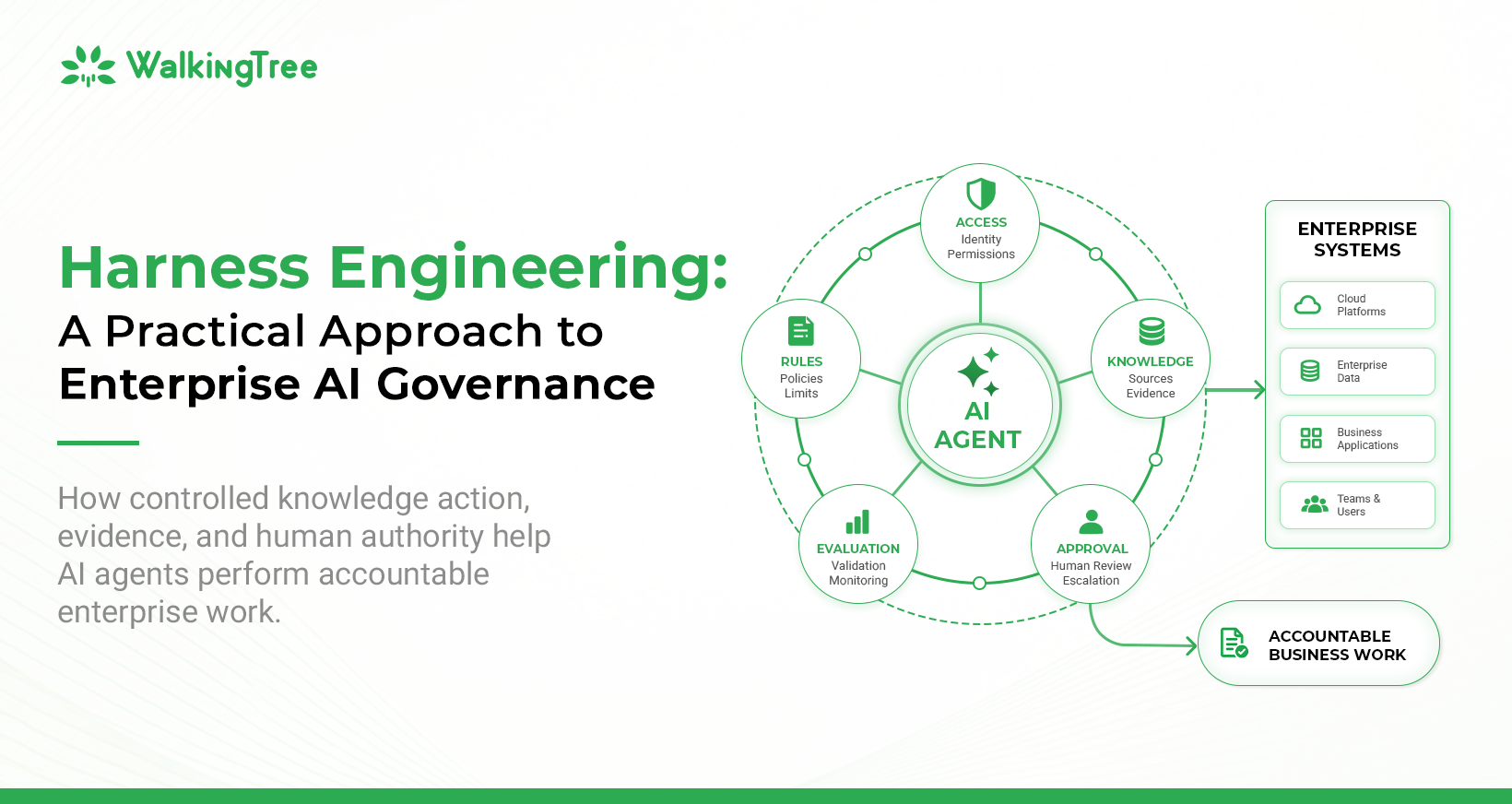 Enterprise AI Governance: A Guide To Harness Engineering20 hours ago ... This aligns with NIST's AI Risk Management Framework (published January 2023) and its companion Generative AI Profile, which provide guidance for managing AI ...walkingtree.tech
 What is AI governance? Principles, frameworks & tooling (2026)19 hours ago ... AI adoption is widespread, while comprehensive governance remains uncommon. Enterprises face a widening gap between AI deployment velocity and the controls ...mintmcp.com