Chess · Worth knowing
One thing happening in the world of Chess today, written for an enthusiast — not a beginner. Skip celebrity gossip. Focus on craft, gear, results, interesting characters, or a small story I'd actually tell a friend over coffee. Quality over quantity.
← Zur aktuellen AusgabeHnatyshyn's upset; English Defence shifts; centaur analysis reveals hidden wins
Hnatyshyn's upset European title
A 15-year-old just rewrote the women's rating ladder.
Anastasiia Hnatyshyn, ranked 76th among 165 participants at the 2026 European Women's Championship, won the tournament outright with 9 points and a performance rating of 2580 [Quelle: ChessBase]. The Ukrainian defeated multiple women grandmasters including Mai Narva (2426) and gained 215 rating points in one event, vaulting to 17th in the world live rankings and first in the girls' under-20 standings. Her trajectory—world rapid and blitz champion at age 11, European Under-16 titles last year, structured work with Adrian Mikhalchishin and five years at Kasparov Chess Academy—shows that upsets this clean are earned through relentless competitive grinding across formats.
This is what a 2580 performance looks like at 15.
English Defence reshuffled
The opening shifted from 3...Bb7 to 3...Bb4+ overnight.
Daniel King's latest analysis in ChessBase Magazine #233 traces how the English Defence (1.c4 b6 2.d4 e6 3.e4 Bb4+) has flipped its main line [Quelle: ChessBase]. King examines White's three primary responses—4.Nc3, 4.Bd2, and 4.Nd2—demonstrating that Black achieves comfortable positions in each through quick castling and central pawn chains on the dark squares. The issue also features Ivan Sokolov's fresh approach for White in the Nimzo-Indian and Mihail Marin's deep dive into Grischuk's exotic 9...e5 in the Gruenfeld.
Repertoire builders: this one landed Friday.
Computer-assisted endgame lessons
The board hides more than most players see.
Jon Speelman's latest centaur analysis examines three competitive positions where computer assistance exposed hidden resources [Quelle: ChessBase]. He revisits Svidler-Lobron (1996 Yerevan Olympiad)—a position Black prematurely resigned that was actually drawn—showing how pawn placement flips evaluations. Two recent Grand Chess Tour games from Zagreb follow: Firouzja-Saric's middlegame where 30.h3 won but 30.Qh6 offered zugzwang tactics, and Keymer-Deac's endgame where removing a single pawn transforms the theoretical assessment from drawn to winning.
The lesson: pawn placement alters everything.
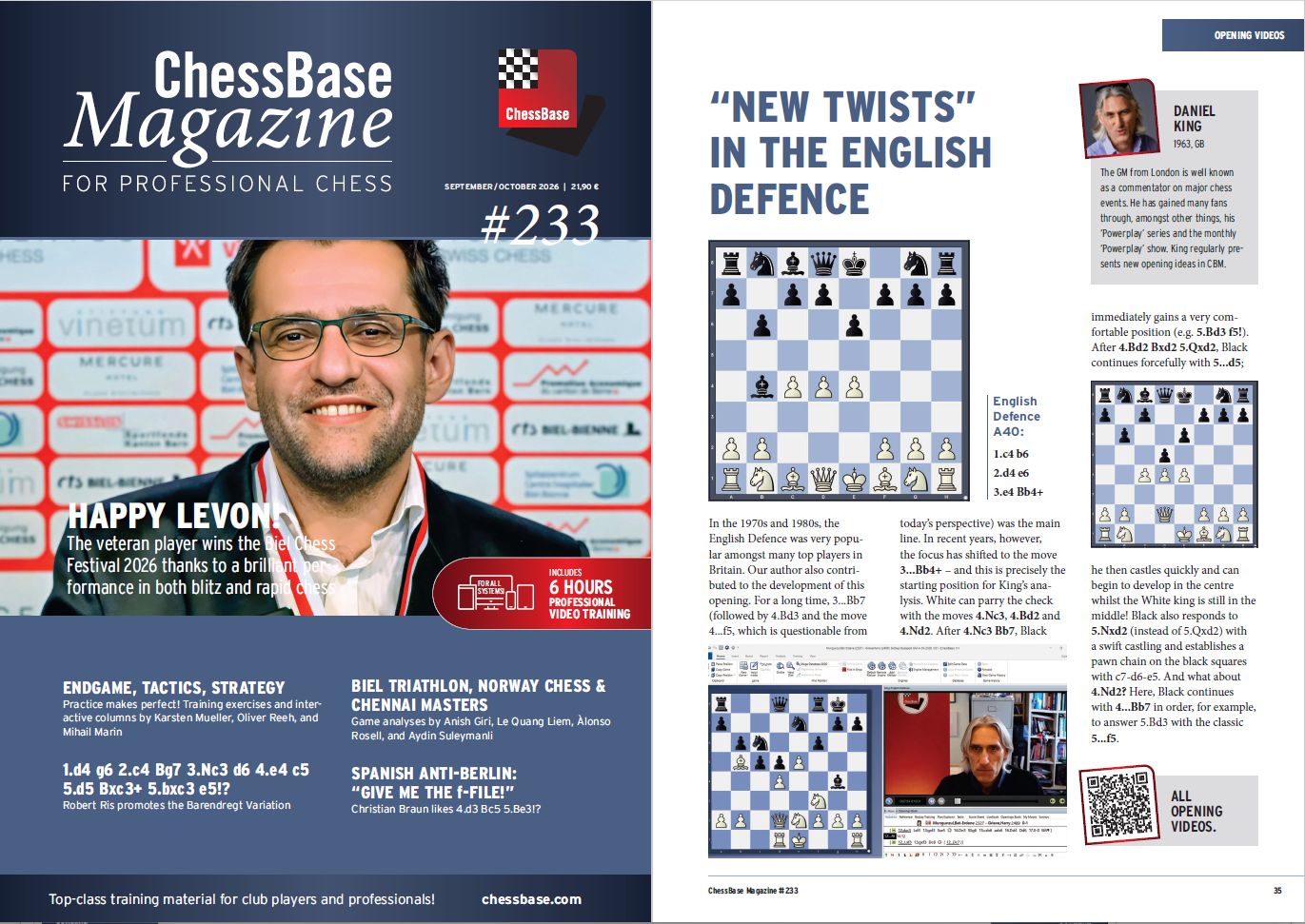 "New twists in the English Defence" | ChessBase3 hours ago ... Opening specialists present the latest trends in opening theory and exciting ideas for your repertoire. Master coaches in tactics, strategy and endgames ...en.chessbase.com
 Jon Speelman: Two legs good, four legs better! - ChessBase20 hours ago ... ... opening theory and exciting ideas for your repertoire. Master trainers in tactics, strategy ... learn more > The ultimate chess experience every day, PlayChess ...en.chessbase.com
 Who is Anastasiia Hnatyshyn? - ChessBase14 hours ago ... The London System is one of the most popular openings at every level of chess but not all Londons are the same. ... Besides in-depth theory and exciting tactical ...en.chessbase.com