AI product management · Industry brief
Top three stories shaping AI product management today, written for someone who already works in the industry: regulation, M&A, new entrants, notable filings, and any precedent worth pulling. Cite the trade publication (e.g. trade press, government source, court docket) directly so I can follow up.
EU enforcement live, M&A surges, Trump's audit accord shapes market
EU AI Act enforcement begins
Compliance just stopped being optional in Europe.
The European Commission's AI Office and national authorities began active enforcement on August 2, 2026, with transparency requirements now in effect and high-risk systems (employment, education, biometrics, essential services) due December 2, 2027 [Quelle: JDSupra]. Prohibited practices have applied since February 2025 and general-purpose model obligations since August 2025. Violations carry penalties up to €15 million or 3% of worldwide turnover, converting governance from discretionary into a funded operating requirement.
SaaS teams now race against the December 2027 deadline—the real bite for product-embedded systems.
AI startups become serial acquirers
Venture-backed AI firms just became a consolidation engine.
Through September 29, 195 acquisitions of AI companies by venture-backed AI firms landed in 2026—14% more than all of 2025 [Quelle: Crunchbase]. OpenAI leads with 20 AI acquisitions (10 this year), while repeat buyers like Legora (five acquisitions in 2026 alone) and Harvey (four this year) account for 42% of all transactions over three years. Vertical startups in legal tech, customer service, and software development are moving fastest, using M&A to fill product gaps and enter new markets faster than organic builds.
The speed advantage in scaling AI justifies deal valuations and minimal dilution to existing shareholders.
Trump's AI accord sets voluntary framework
Voluntary commitments just became de facto governance standard.
On September 29, leading AI executives (Anthropic, Google, Meta, OpenAI, Nvidia, xAI) signed the White House Accord on Super Intelligence, establishing a four-layer framework: internal controls, internal verification teams, independent external audits, and board-level oversight [Quelle: ConsumerFinanceMonitor]. Though legally non-binding with no federal enforcement, it mirrors auditing frameworks in financial services and healthcare. The FTC launched a broad investigation into frontier developers the day after signing, signaling the Accord will likely inform future regulation.
Expect auditor qualification standards and independence criteria to harden over the next 18 months.
Agentic governance platforms hit inflection
Governance just became a funded, measurable operating function.
The global agentic AI governance platform market reached USD 7.3 billion in 2025 and will reach USD 203.2 billion by 2035 (39.5% CAGR), driven by EU enforcement and rising organizational adoption from 78% (2024) to 88% (2025) [Quelle: Market.us]. Google's $32 billion acquisition of Wiz, IBM's $11 billion purchase of Confluent, and ServiceNow's $7.75 billion Armis deal underscore investor conviction that governance infrastructure is strategic, not tactical. Documented AI incidents rose 55% (233 to 362) despite rising adoption, proving that speed without controls now carries material risk.
Teams embedding governance into agent behavior are outpacing those treating it as a gate.
 EU AI Act, U.S., UK, China, and Key Compliance Risks for Companies24 hours ago ... Transparency is one of the clearest examples of AI regulation moving directly into product design. ... regulatory compliance, and legal risk management.jdsupra.com
 Crunchbase Data Shows AI's Most Active Startups Are Becoming ...16 hours ago ... The specific companies being acquired offer insight into what AI startups hope to gain from their stepped-up M&A activity. OpenAI's purchases have ranged ...news.crunchbase.com
 Trump's AI Accord: Can Voluntary Self-Regulation and Independent ...6 hours ago ... As stated above, that architecture is hardly unique to AI. Variations of it are already embedded in numerous corporate compliance and risk-management regimes.consumerfinancemonitor.com
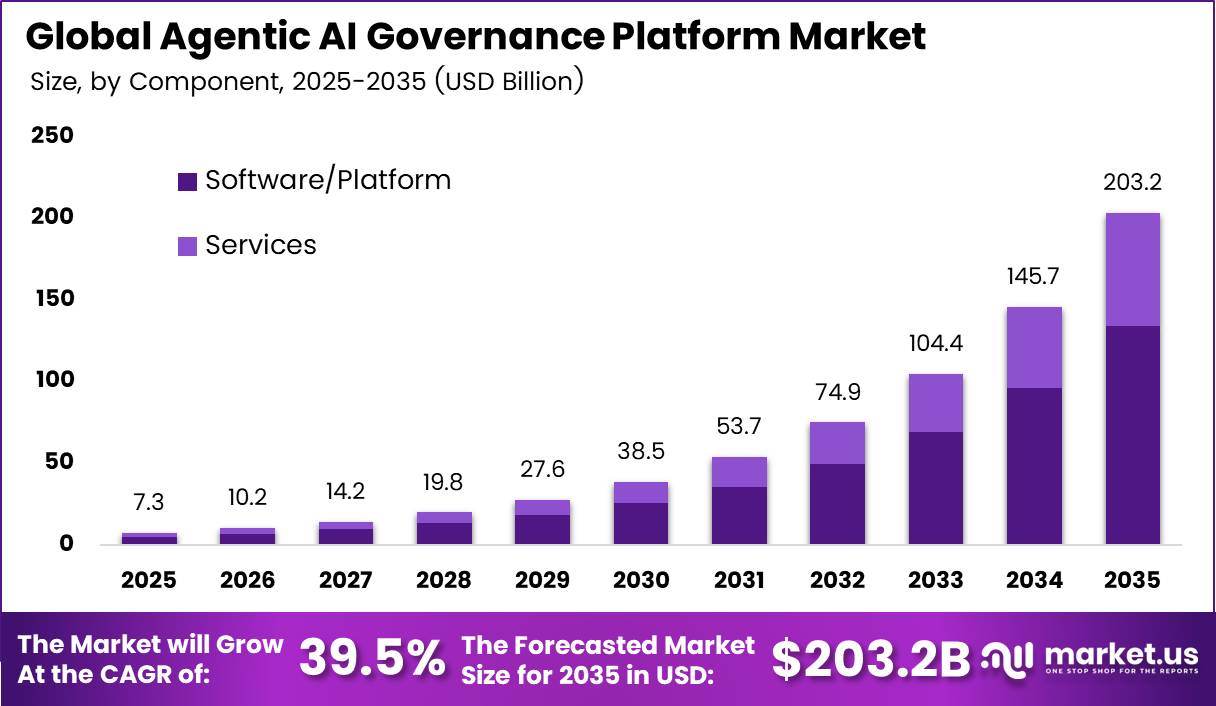 Agentic AI Governance Platform Market Size | CAGR of 39.5%22 hours ago ... Agentic AI Governance Platform Market Size, Share and Report Analysis By Component (Software/Platform, Services), By Deployment (Cloud-based, Hybrid, On ...market.us
Mehr aus Tech
- Senior AI EngineeringLass alles weg, was nach Pressemitteilung oder Marketing klingt. Gehe auf die neuesten Entwicklungen ein, die als Senior Software Engineer wichtig sind: Bspw. neue LLM Modelle, wirklich neue Tools und Frameworks zur AI Entwicklung und Best Practices.Lesen
- Software Engineering with AI AgentsLatest news about AI, AI Coding, Best Practices, New Models, Anthropic Releases, Expected new models. Focus on advanced techniques and consider that I am a Senior Software Engineer with a lot of experience. Focus on advanced techniques on how I can improve my coding workflow & stay up to date.Lesen
- KI-Produktmanagement · Branchen-BriefingDie drei wichtigsten Stories, die KI-Produktmanagement heute prägen, geschrieben für jemanden, der bereits in der Branche arbeitet: Regulierung, M&A, neue Marktteilnehmer, wichtige Filings und Präzedenzfälle. Fachpublikation (z.B. Fachpresse, Behördenquelle, Gerichtsakten) direkt zitieren, damit ich nachrecherchieren kann.Lesen
- KI-Entwicklertools · Was kam heuteFür eine erfahrene Engineerin, die ohnehin HN liest. Echte Veränderungen bei KI-Entwicklertools heute: Releases mit Versionsnummern, Paper mit Benchmarks, Repos, die eine relevante Schwelle überschritten haben. Hype-Threads, Pre-Announcement-Leaks und recycelte Zusammenfassungen überspringen. Immer Originalquellen verlinken.Lesen
- IT-Sicherheit · Branchen-BriefingDie drei wichtigsten Stories, die IT-Sicherheit heute prägen, geschrieben für jemanden, der bereits in der Branche arbeitet: Regulierung, M&A, neue Marktteilnehmer, wichtige Filings und Präzedenzfälle. Fachpublikation (z.B. Fachpresse, Behördenquelle, Gerichtsakten) direkt zitieren, damit ich nachrecherchieren kann.Lesen