HR and future of work · Industry brief
Top three stories shaping HR and future of work today, written for someone who already works in the industry: regulation, M&A, new entrants, notable filings, and any precedent worth pulling. Cite the trade publication (e.g. trade press, government source, court docket) directly so I can follow up.
← Zur aktuellen AusgabeAI anxiety dominates employer concerns, elastic workforce tech emerges
AI and data privacy top concerns
Employers are pivoting their compliance playbooks hard toward AI and data privacy.
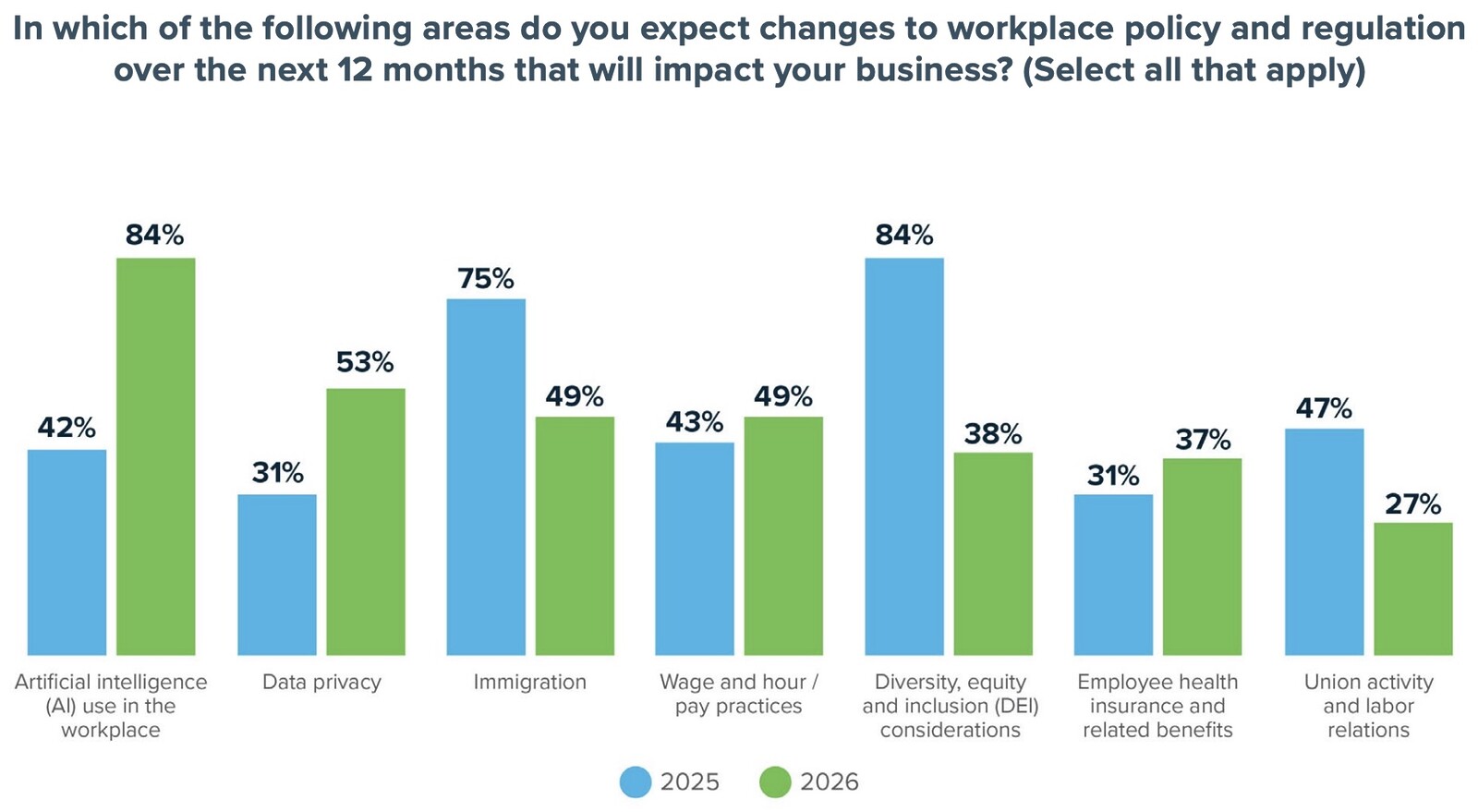
Littler Mendelson's 14th Annual Employer Survey of over 300 C-suite executives and HR professionals found that 84% of respondents expect AI-related policy changes to affect their business in the coming year—double the previous year's figure [Quelle: CBIA]. Data privacy concerns jumped to 53% from 31%. The gap between concern and readiness is stark: only 55% have formal review processes for AI tools, and 54% are restricting data entry, leaving 79% of employers worried about litigation exposure tied to AI governance failures.
This anxiety signals where enforcement will follow.
AI adoption reshaping headcount strategy
More than a third of employers have already restructured jobs around AI efficiency gains.
The same survey reveals that 20% of firms have frozen hiring and 15% have cut workforce due to AI adoption [Quelle: CBIA]. Workplace accommodation litigation concerns jumped 17 points to 67%, reflecting a widening tension: employees expect flexibility and remote work while executives mandate return-to-office. Meanwhile, 92% of employers experienced staff departures involving potential breaches of restrictive covenants or misuse of confidential information—a signal that departing workers are taking institutional knowledge and competitive advantage with them.
The convergence matters: AI is cutting roles while enforcement around employee departures tightens.
Elastic HR tech reshapes workforce planning
Static workforce planning is obsolete; dynamic ecosystems are the new standard.
Elastic HR Tech combines AI, automation, and real-time workforce intelligence to enable organizations to scale capacity and skills on demand rather than through annual cycles [Quelle: Tech R Series]. Predictive analytics forecast talent demand, identify skills gaps, and anticipate attrition, shifting decisions from boardroom planning to continuous scenario-based adjustments. Implementation barriers remain steep—legacy systems, data quality, algorithmic bias, and employee adoption resistance—but the technology fundamentally repositions HR from administrative function to strategic intelligence hub.
Organizations that build this infrastructure now lock in competitive advantage in the talent war ahead.
 Survey: AI Anxiety Tops Employer Concerns - CBIA22 hours ago ... ... enforcement and workplace accommodation ... policy and enforcement changes, including clarifying processes and preparing for worksite enforcement activity.cbia.com
 Elastic HR Tech: The AI-powered Blueprint For Limitless Workforce ...8 hours ago ... These technologies support everything from workforce planning and talent acquisition ... retention periods, and permitted uses of workforce data in ...techrseries.com